

Performances
Writing & other encounters
Content types
Tags
- Plays (7)
- Grace (3)
- Cheruta (3)
- Twenty Two Pictures (3)
- The Dybbuk (3)
- Warlike Collage (3)
- Ruthie Osterman (2)
- I am. I am. I am (1)
- Performance Practices & Research (1)
- Babylon Beyond Borders (1)
- Bush Theatre (1)
- Live Stream (1)
- Postal Delivery to God (1)
- ZSPERA'42 (1)
- Theatre du soleil (1)
- Antigone (1)
- Sophocles (1)
- Euripides (1)
- Iphigenia in Aulis (1)
- Arian Mnushkin (1)
- Up Next (1)
Links
Links
On Rabbi Lord Jonathan Sacks, Dunstan Road Shul and a missed conversation
On my first Shabbat in London, 8 years ago I was looking for a synagogue to pray. I was not familiar with the area but knew that Golders Green is a Jewish neighbourhood and finding a synagogue should be an easy task.
I saw an Orthodox man walking on the street and decided to follow him as it was clear that he was on his way to the Shul. Suddenly he turned to me and asked if I needed anything. I replied to him that I was new in town and that I was looking for a synagogue. He looked at me carefully and said that his Shul was not for me but directed me to another Shul on Dunstan Road. He was certain that this was the Shul I should attend.
I followed his instructions and reached the old nice building of Golders Green Synagogue, which was full of people mainly older than me but there was something trustable and solid there, so I decided to stay. And while pursuing my master degree in theatre, every Shabbat I attended that Shul. People used to tell me that I should find a younger Shul where I could find a nice Jewish boy… but I didn’t want to. This Shul with its character and very interesting intelligent and super nice community attracted me. I found friends there that became family and surprisingly or not, I also found my husband there. Or more precisely, the people there found my husband for me. So, Dunstan Road Shul has a special place in my heart.
One Shabbat in 2013 Rabbi Lord Jonathan Sacks came to the Shul. The community was very happy and excited and in his Drasha he spoke about returning home. Rabbi Sacks had just terminated his long service as Chief Rabbi of the United Hebrew Congregations of the Commonwealth and returned to his Shul. Since then, whenever I attended the Dunstan Road Shul, I had the great pleasure and privilege to observe Rabbi Sacks sitting on the first row with his noble presence.
It is very sad to speak about Rabbi Sacks in the past tense. A lot has been and will be said about this great man, one of a kind and a really “Gdol HaDor”. There is not much I can add, but I can tell who was Rabbi Sacks for me. An exemplary living figure, a great Rabbi and a philosopher who I had the great honour to see with my own eyes. Not only to read his text but to read and learn his presence, his Halichot – filled with wisdom, majesty and modesty.
When you observed Rabbi Sacks, heard him or read his words, you had this inner feeling and strong recognition that you are encountering a great man, a great thinker, a great soul. This was clear and beautiful.
Later, when we moved to another area, we went to another Shul and used to visit Dunstan Road from time to time. Whenever we attended the Dunstan Road Shul, we always looked to see if Rabbi Sacks was there. Ari used to seat not far from him on the first row and this always caused me a little embarrassment. I remember that one Shabbat my little son Eliya played with Rabbi Sacks’ Siddur and act as if he was praying from it. Rabbi Sacks was very kind and collaborated with him. Today I am so grateful for those little moments and the Zchut to be physically close to him.
A couple of years ago whilst I was working on a stage adaptation of the book “My Mother My Grave” by Yair Neorai, I came across Rabbi Sacks’ book “Not in God’s Name”. I found this book very important and extremely powerful, speaking of the crucial problem I believed the world was facing. I decided to try and combine this text and adapt it to stage as part of the play I was writing. I had been facing Rabbi Sacks Several times at the Shul and wanted to ask him about his book, to get his advice, to get his permission to adapt it. I wanted to share with him how close I was to his book, reading in it back and forth and wanted to thank him for writing it. But as it often happens when you stand in front of a great man, you (or at least I) stayed speechless. I could not find the courage to speak to him, therefore the play never got finished.
When I heard on Motzaey Shabbat last week that Rabbi Sacks had passed away, I was shocked and very sad for this great loss. Sad for the world, sad for the Jewish Community, sad for his family and friends in Dunsten Road Shul and sad for myself.
I will continue looking for Rabbi Sacks when we will come to the Dunstan Road Shul, I will continue looking for the right moment to speak to him and prepare for our meeting. His legacy is still alive, the learnings are still alive and so that the inner conversation with him. Sometimes, the things that never happen are those who continue to stay alive.
Thank you, Rabbi Sacks, for our missed conversation and for the honour I had to observe you sitting on the first row.
Babylon Beyond Borders – R&D workshop
November 2018, Bush Theatre, London

Babylon Beyond Borders is an international collaboration between the Market Theatre Lab in Johannesburg, Harlem Stage in the New York, Pequeno Ato in São Paulo and the Bush Theatre in London.
Four extraordinary theatres, each deeply rooted in its own community, collaborate and explore their relationship to Babylon and it’s meanings, from home and exile to migration and language. The outcome is performance that takes place simultaneously and projected via live stream
To read more about the project: Babylon Beyond Borders, Bush Theatre
In this project we explore the possibility of sharing one space by creating a performance that will happen in four locations simultaneously using live stream. We hope to offer our audiences the possibility a meaningful encounter with audiences and artists in around the world. This simultaneous event will celebrate cross-border solidarity and creativity.
Each theatre appointed lead artist to devise the work. Beside myself, the other lead artists are:
Pedro Granato, Artistic Director of the theatre Pequeno Ato in São Paulo, Brazil.
Mwenya Kabwe , Theatre maker from the Market Theatre Lab in Johannesburg, SA.
Sarah Elizabeth Charles, Composer and musician from Harlem Stage in New York City, US.
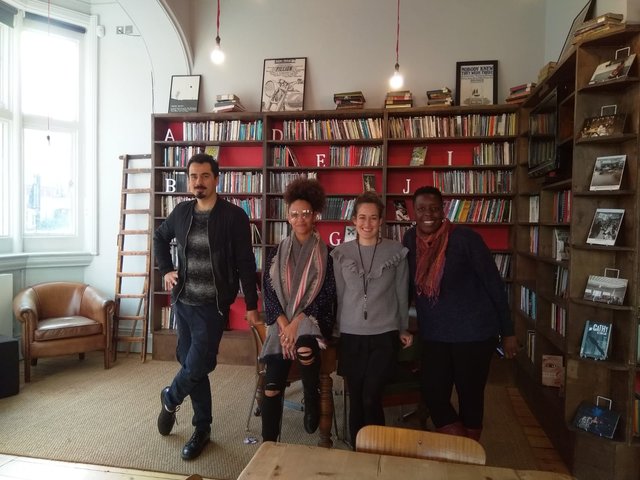 Pedro, Sarah, Ruthie and Mwenya at the Bush Theatre, London.
Workshop in London
A crucial and exciting moment in our creative process was the only moment when all four international artists met for an intensive R&D workshop at the Bush Theatre in London. Till that moment and after that moment our meetings will take place only online, but for one week, we used the old and beloved fashioned way of sitting together in the same room.
First day
Visa Application
Pedro & Mwenya arrived in London. Having Mwenya here on time was kind of a miracle. She had to go through a torturing visa application process and we were not sure if she will get it on time. A day before her flight, she’s got a phone call saying “please come to collect your passport”. To start with a miracle is always a good sign. And also, as we will see later, the visa application became a vital part of the performance. Like they say “When life gives you lemons, make lemonade…” new-agee as it might sound, it did worked like that. The visa application and the experience of the UK border control are going to play a great role in our work.
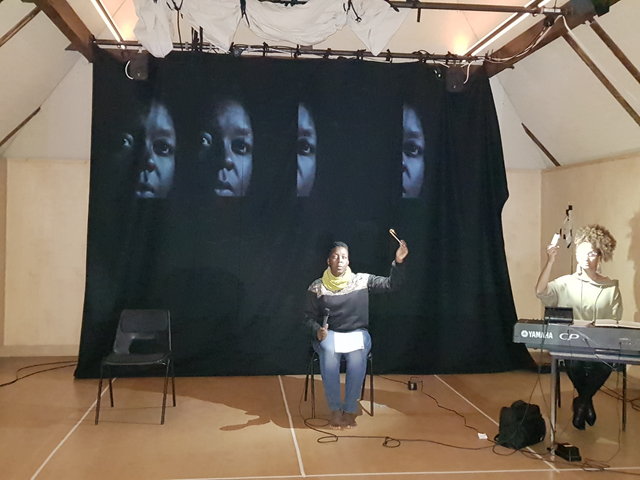 Mwenya and Sarah exploring light.
What they would like to know? Mwenya reading to us the questions from her visa application.
Encounter
First discussion was about goals. We were talking about concept and goals; why we are here? what we would like to achieve? The banal yet important questions… I was talking about the Arab Springs. I know this ended up very bad, but again, this image of squares burnt simultaneously in various places around the world, made me think a lot. Can we create an artistic action that will happen simultaneously around the world? Can it have a powerful impact?
Perhaps I should start from the very beginning – from me doubting my profession, questioning the meaning of theatre.
People ask me why I am so obsessed with international collaborations? Why I must be in one place and speak to another? Is it my Jewishness and my diasporic roots? Is it luck of satisfaction from wherever I am? Is it a childish wish to travel abroad? I think the real answer is that I believe it makes me a better person. I remember very well my first international collaboration with Polish artists. Me, who grew up with Holocaust’s survivors, who were educated to hate Polish people, to never forget and never forgive. I collaborated with the Polish people, performed on Polish soil, and yes – it was transformative and made me a better person.
I believe in the power of the encounter.
Books
Brazil is burning. Far-right candidate Jair Bolsonaro wins presidential election in Brazil . Pedro is worrying. He is going to be a father soon, and he is worrying about the future of his daughter, and about the future of his country. He sent us a link to their protest “We will fight guns with books”. Books. First association that came to mind is Heinrich Heine’s quote “Where books are burned, in the end, people will also be burned”. Well, history. An idea comes to mind, we should work with this image. I see a stage full of performers dancing with books. Perhaps an artistic action with books? Audience engagement?
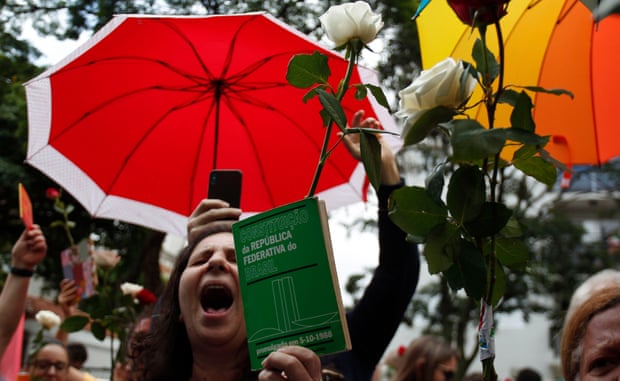 Books on the front line … a Workers Party supporter holds a Brazilian constitution during the second round of the presidential election on 28 October. Photograph: Miguel Schincariol/AFP/Getty Images
To read about Brazil’s cultural-political resistance
Possibilities
The first day of the workshop ended up with possibility. We all agreed that we would like to end the performance with a sense of possibility.
I imagine a very fragmented work, a collage. I’m not afraid of not having a linear narrative. Life is not linear. Life for me is more fragmented, broken. Identity is fragmented, broken, eclectic. So why a narrative should be linear?
We are finishing the first day with a list of inspirations, from Mujica – the mythological president of Uruguay, through Afrotopia and the Zambian “Afronaut”- who wanted to join the space race, till Charly Chaplin.
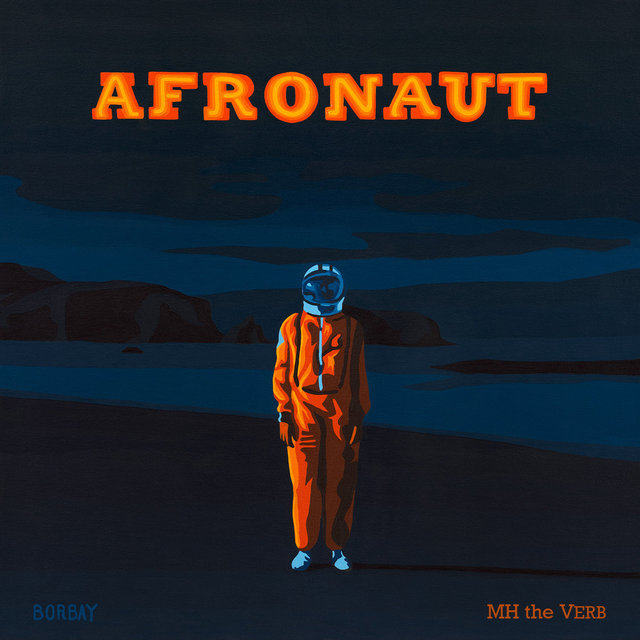 [/still-images] Conversation about Afrotopia. The Zambian “Afronaut” Who Wanted to Join the Space Race
Mujica – an inspiration
Chaplin – a possibility
Second day
We have started the day with “meet and greet” with the Bush Theatre’s staff. This is a beautiful tradition when all staff members are coming to welcome new artists/company who are coming to work in the building. Really beautiful and inspiring. We will meet the staff again for a sharing at the end of the workshop. Many people have helped me to make this workshop happen and to realize my vision for this international collaboration, many people also thought that it’s too ambitious, too conceptual, and mainly depend on budget. If there is something that I have learnt from doing international collaborations is that I must imagine that it’s already happened. There is no question about it, it’s already happen.
Then each one of us shared his/her vision, gave some background and political and social context to his/her location. What is the Market Theatre? Harlem Stage? What does it mean to work in the heart of São Paulo? And in the middle of London – the modern Babylon? From post Apartheid to Brexit to Brazil’s elections and to gun in school in Harlem. Is there a link?
We had prepared a list of questions for people from our communities. We answered those questions ourselves, Sarah was thinking of writing a song out of it. Questions. Mwenya was sharing with as a Ted lecture by Taiya Selasi, who suggested to ask alternative questions. Don’t ask where I’m from, ask where I’m a local.
Don’t ask where I’m from, ask where I’m a local | Taiye Selasi
Afternoon we invited Julian Mayard Smith, the Artistic Director of Station House Opera to speak with us about his telematic performances. Their interesting works Dissolved and Home in London & Gaza are very inspiring. Julian explored how to do something using technology that you cannot do on stage? How to occupy another space? Using live stream, you can allow one performer in London to walk in another space in Gaza, as if you are a ghost.
Card & Rules
We put all the “cards” we had on the table. Actually, I should say on the wall. By cards I mean scenes, ideas, fragments. And we were starting to discuss them, refined them, and choose the best. We also agreed on our “Dogma rules”.
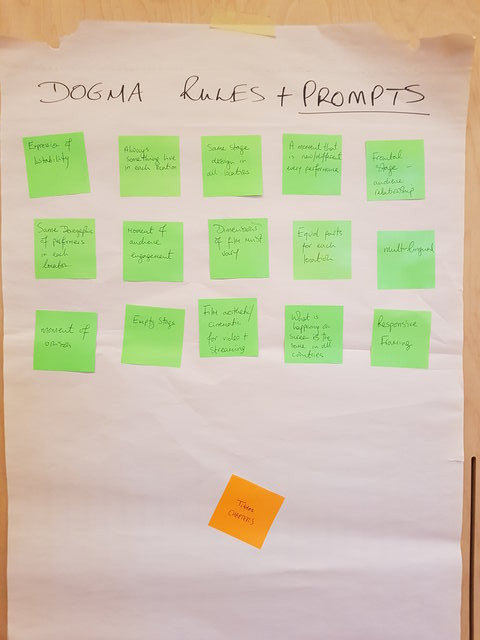 Our Dogma Rules version 1
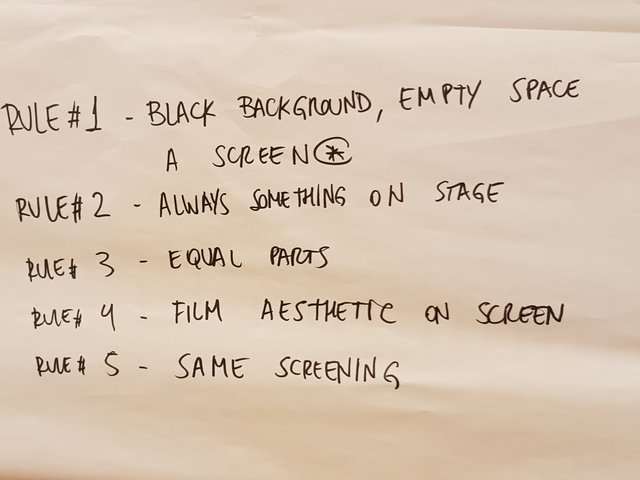 Our Dogma Rules version 2
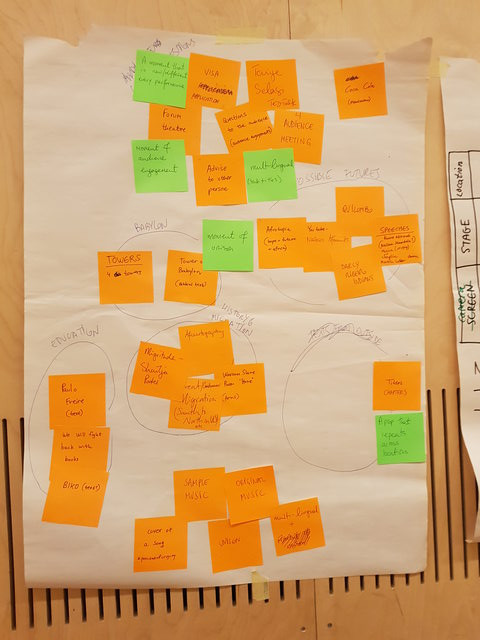 Cards
Cards
Towers of Babylon
We suddenly realized that we all have Towers connected to a traumatic event. Towers that evoke stories that tell something meaningful about our communities. Towers that evoke critical social and political topics. We shared the stories of our towers. Johannesburg has Ponte, São Paulo has the antique building of the federal police, New York City has the Twins Tower, and here in London, we have Grenfell Tower.
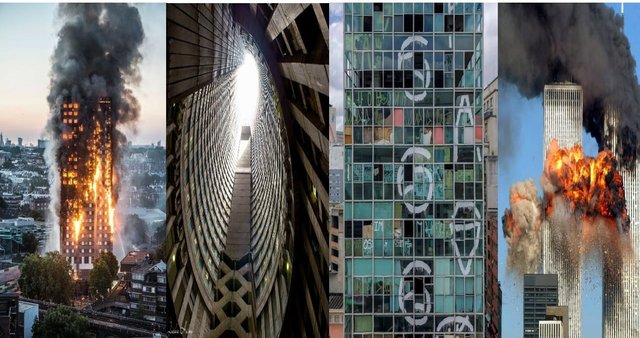
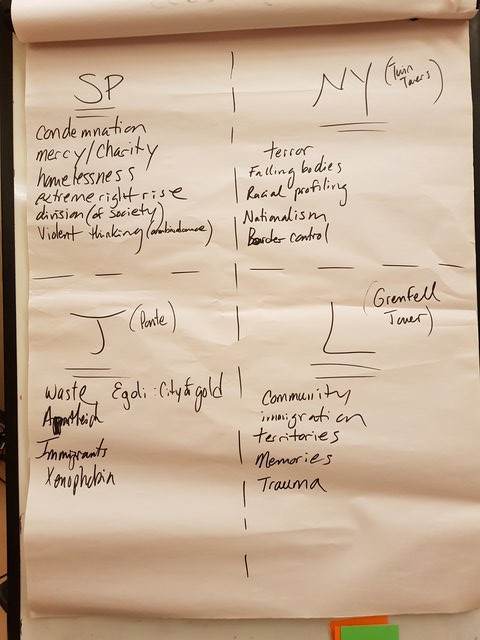 What our towers tell us? topics around our towers
Third day
Live stream. Heather, our live stream producer, explained us how it is going to work. We are going to perform live in four countries in front of live audiences, to capture what is happening on stage and live-stream it simultaneously to other three locations.
Beside it, we will live stream the all event on social media.
What is important for me is not the live stream itself, but rather the artistic and political possibilities that it allows us. So, we played with form, played with layered images from different locations, and with the relationship between the projected image and the live body etc. Live stream is a virtual journey of image and sound.
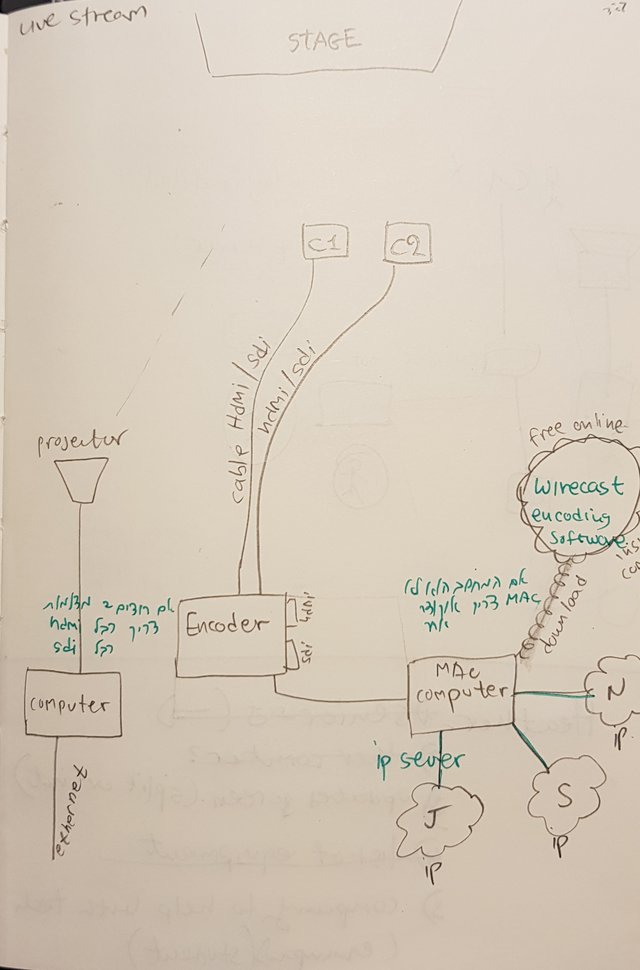 Live stream is a virtual journey of image and sound.
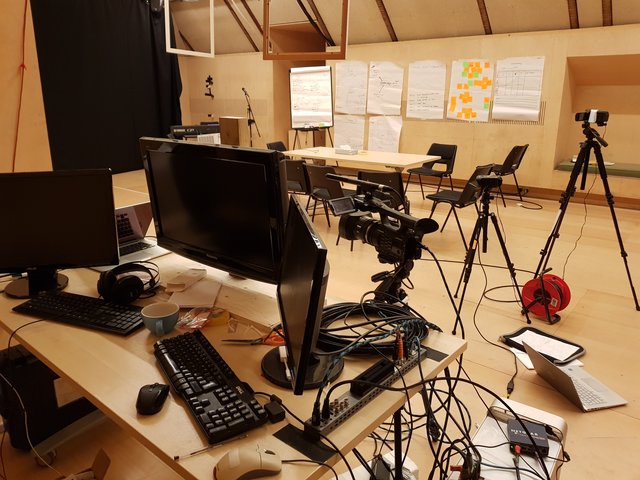
Heater shared with us a hilarious video of the talkback of the Eurovision in 1977. How to not do it…
Home
During the process we came across the amazing poet Warsan Shire. In her book “Teaching my mother how to give birth” , she has a wonderful poem “conversations about home”. We read the poem and worked with it. Sarah loved the poem and composed it.
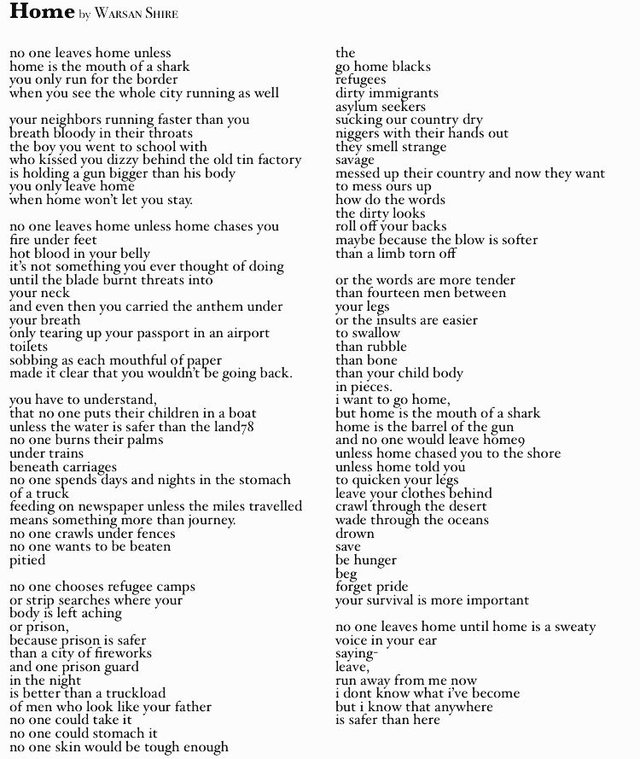
We were trying to understand what the performance is all about. To tight the concept. Perdo said it is not about towers, it is about home.
We were sitting around round table in a wine bar next to the Theatre. We were thinking about home, asking questions about home, understanding the differences between our homes, sharing our issues with our home. We were playing with words. We were looking for words with ‘home’ inside them:
Homeland, Homesick, Homeless, Homemade, Homage, Homeward, Homecoming, Hometown, Homebound, Homerun.
Sharing
On Friday morning we had a sharing with the Bush Theatre’s staff . We sent over a link, so that people could watch it online. Testing the live stream… We were facing one camera towards half of the audience, and a second one toward the other half, as if they were in two different countries. We performed two scenes and shared the concept with the team. We got warm and interesting feedback. Obviously, the fear growth as it became more and more real. We were planning ahead, wrote a work plan, scheduled our next online meetings and rehearsals . We put together all the materials we had and said goodbye. We won’t see each other anymore, at least before the performances. It is strange but also beautiful. This is what we explore – how can you create a meaningful encounter without being present in the room, how to connect to a person who is far away, how to care about another country, how to feel for other communities?
Now each of us goes away to work on its own and we will meet each other online on a weekly basis. The workshop was very good. It was very intensive, but also fun and meaningful. I’m so glad it happened. I am so looking forward to seeing what will come next. To end with possibility.
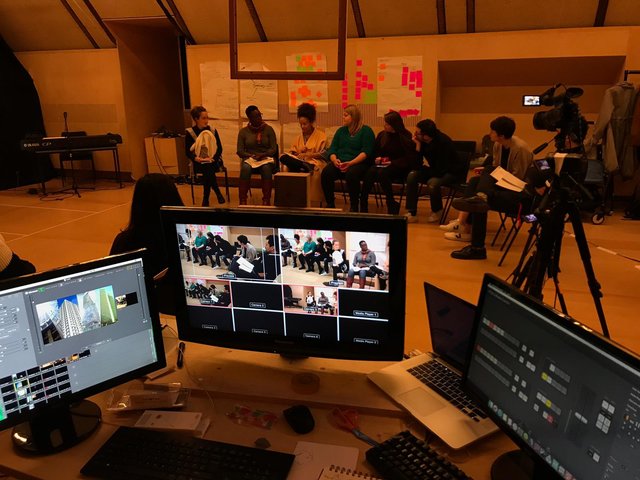 Sharing with the Bush Theatre’s staff
Sarah’s voice, R&D workshop in London, November 2018
Beyond the archiving principle
Freudian reflections on the archive
Ruthie Osterman, London , 2013.
“It is to burn with a passion.”
(Derrida, Archive Fever, 1996:91)
In this essay I would like to analyze an artefact that I created as part of my ‘Archiving Practice’ unit in the Royal Central School of Speech and Drama by using Freud’s notion of the ‘uncanny’ (1919) and the philosopher Jacques Derrida‘s understanding of the archive as it is presented in his book Archive Fever – A Freudian Impression. Through describing and analyzing the process of creating my artefact, I will present the way I see the archive as an open, inviting and even chaotic space of encounter.
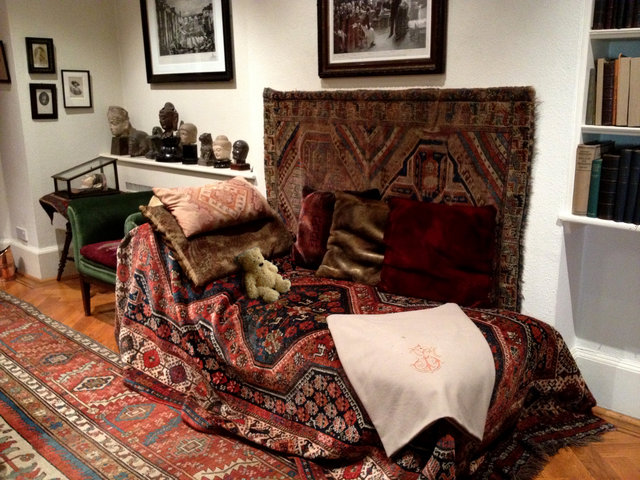
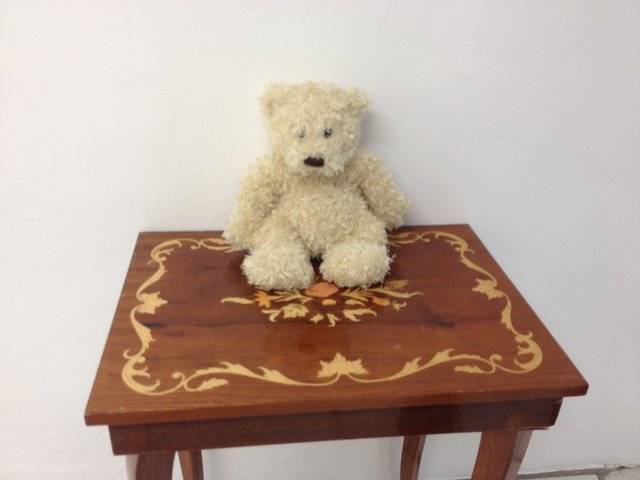
In May 2013 as part of an ‘Archiving Practice’ unit in my MA studies in London, I visited ‘Freud Museum’ for the first time. I was overwhelmed by the place and Freud’s collections, having a weird feeling that this place is familiar and unfamiliar to me at the same time. It was forbidden to photograph in the house; nevertheless, I took pictures of almost everything in the house, thinking that it is probably the best place to give freedom to my sins. (I also thought to myself that if I get caught, I will immediately lie down on the couch, ready for my psychoanalysis …) When I observed the photos I started to see and imagine things in the archive which did not really exist there. I saw my old Teddy-bear from my childhood lying-down on Freud’s couch as if it were the perfect place for it. At that moment I thought about things in the archive which do not really belong to the archive but still exist within it. They belong and don’t belong at the same time; to use Freud’s word they are ‘uncanny’ in the archive.
“At that moment I realised that there is a hierarchy within the archive and that someone should ‘take care’ and be the guard of the archive. It made me think about the inner-archive, and when I say ‘inner- archive’ I mean memory; I mean the body. Does the inner-archive have a guard too? Who controls the inner-archive and doesn’t let strange things get in? Who is the visitor of the inner-archive and what is he doing there?”
Freud, in his essay ‘The Uncanny’ (1919), explains that ‘the uncanny is that class of the terrifying which leads back to something long known to us, once very familiar.’ (Electronic version, p: 1) It is something which is unknown yet familiar at the same time. This expresses quite well the feeling that I had when I entered the Freud Museum. What caused this feeling? Freud said that ‘Something has to be added to what is novel and unfamiliar to make it uncanny’ (ibid). It is not by chance that I felt uncanny in Freud’s House. The word ‘unheimlich’ is the opposite of ‘heimlich’ which in German means ‘belonging to the home’. What kind of home/house/museum is the Freud Museum?
I decided to ‘catch that moment’ of my encounter with this archive and to ask for permission to photograph my old teddy-bear on Freud’s couch, just as I saw it in my imagination.
I will deliberate later in this essay the way I read and understand ‘archive’ as a space of encounter and performance within the archive. I wanted to create an artefact which plays with the possibilities of the archive and brings together two significant elements from two different archives: the old teddy bear from my private archive and Freud’s couch from the Freud Museum. (a public archive)
I went to the Freud Museum to introduce my idea and I was asked to contact the curator of the Museum, Miss Sophie Leighton, and the producer of the Museum, Miss Bryony Davies, through email. I did so(see appendix 1 ). I got no response. A week later, I returned to the Museum and waited in front of its main door before opening time for someone to talk to. I brought my teddy-bear with me, thinking that I might find some way to insert the teddy-bear into the house.
A man, whose position in the museum was unknown to me, was the first person to come in and I took the opportunity to ask his permission to photograph my teddy bear on Freud’s couch. He asked me a lot of questions and was very interested in my idea. After my explanation, he told me that he doesn’t think that I will be able to photograph my teddy bear on Freud’s couch but I might be able to photograph it on Anna Freud’s couch on the second floor. He explained that ‘She used to work with children and the teddy bear is from your childhood so it’s the right place’. I disagreed and told him that I was interested in putting the teddy bear only on Freud’s couch. After his failed attempts to convince me that I am actually speaking about ‘Transitional object’ or ‘forced memory’, he asked Bryony, the producer of the Museum, to come and speak with me. She explained to me the politics of the Museum, its hierarchy and why I will not be able to take this photo:
“The Couch is so precious, it is an icon and we cannot let people put things on the couch. You know, even me and Sophie (the curator), we don’t even touch the couch”
At that moment I realised that there is a hierarchy within the archive and that someone should ‘take care’ and be the guard of the archive. It made me think about the inner-archive, and when I say ‘inner- archive’ I mean memory; I mean the body. Does the inner-archive have a guard too? Who controls the inner-archive and doesn’t let strange things get in? Who is the visitor of the inner-archive and what is he doing there?
I see myself as a live archive and sometimes I can find objects, thoughts or even feelings within this archive, which do not belong to it, which do not belong to me. However, they are there. I might call them ’the uncanny in my private/inner archive’. They belong and do not belong at the same time. Yet who put them there?
I was standing in front of the producer of the Freud Museum, trying to explain to her my encounter with the archive, trying to fight for preserving the beautiful and intimate moment that I had with the archive when I saw the image of my teddy bear on the couch at the first time; but for her, the archive is closed.
I thought about Jacques Derrida coming to this house on June 4 1994, speaking about his understanding of an archive:
“As much and more than a thing of the past, before such a thing, the archive should call into question the coming of the future … it is a question of the future, the question of the future itself, the question of a response, of a promise and of a responsibility for tomorrow”
(Derrida, 1996:34-36)
Derrida, in his book Archive Fever, explains that the archive is thus not merely a question of the past. The archive is not closed, but always marked by the openness to the future. It is a question of a response. I agree with him and therefore for me the archive always holds an invitation.
I see the archive as a place for an encounter. If I had to refer to the archive as a character in a play, I would say that its main action is waiting, like a lover for his beloved. The archive is actually waiting for a partner; it’s thirsty for a relationship with the one who will come to visit it. The archive holds the past but also hold some promise for the future.
Derrida said that the archive’s biggest secret is that it’s not static. He spoke about the archive’s own performance. ‘The archive folds the past into a differed time of much future work’ (ibid) It suggests a future for the past.
I think that the archive and the act of archiving play a very interesting role in our life due to the deep connection to existential issues such as death and life. I do agree with Derrida that there is a complexity within the notion of archiving; on one hand there is a passion for the archive, as Derrida said, ‘it is to burn with a passion’ (1996:91) but on the other hand, there is some desire to destroy the archive, a ‘death drive’ within it which creates both actions:
“It is to burn with a passion. It is never to rest, interminably, for searching for the archive right where it slips away. It is to run after the archive, even if there is too much of it, right where something in it an archives itself. It is to have a compulsive, repetitive, and nostalgic desire for the archive, an irrepressible desire to return to the origin, a homesickness, a nostalgia for the return to the most archaic place of absolute commencement.”
(Derrida, Archive Fever, 1996:91)
The archive evokes longing and passion and in my case in the Freud Museum, the archive evoked also something uncanny. Derrida speaks about ‘homesickness’ and fever and therefore I think that it is not by chance that I felt the ‘uncanny’ which has something threatening within it: the desire to preserve the archive and also to destroy it at the same time. There is a tension driven by the ‘death drive’. How should I read my desire to combine these two elements, my teddy bear and the couch, as preserving or as destroying? Maybe both. Was my passion for photographing my teddy bear on the couch actually to offer chaos to the archive? Walter Benjamin in his essay Unpacking my Library says that ‘every passion borders on the chaotic, but the collector’s passion borders on the chaos of memories’ (1999:60) I think that what I saw in the Freud Museum was a chaos of memories, which invited me to add something from my own memory to that chaos.
The producer almost threw me out of the house when the man came back and started to ask more questions. He was very interested in the results of our conversation and tried to keep it up. He asked me:
“Do you have your teddy bear with you?”
At that moment I was very embarrassed, but I answered:
“Yes.”
“Can I see it?”
“Yes.”
I took out the teddy bear from my bag and showed it to the man. It was a very revealing moment. I realized what I was offering to the archive and how private and intimate was my meeting with it. I stupidly apologised:
“It’s a very simple teddy bear.”
The man took the teddy bear and said:
“I don’t think it fits the couch at all; it is much more suited to Freud’s collection”
Without thinking a lot, he took the teddy bear and went with him to the other side of the room. He started to move Freud’s small sculptures and put my teddy bear on the shelf between them. I thought to myself ‘that’s it, you are already in the archive; the performance of the archive has already started’.
“What do you think?”
I didn’t have time to answer, with the producer lowering the teddy bear off the shelf and giving it to me. She said:
“As I told you, I need to speak with Sophie, the curator, and we will send you an answer through email. Please don’t just turn up here as you did today. We will send you an answer. “
Did she realize that she was actually offering me another form of archiving? That the email itself has so much to do with archiving, as Derrida suggested nine years ago in the same lecturer? Probably not. She wanted to see me, my teddy-bear and maybe also her colleague out of the Museum. We had interrupted the silence of the archive enough for today.
On my way out the man told me:
“You should use Photoshop. You are speaking about ‘forced memory’ and not about reality. What really happened is not important. You see your teddy-bear on the couch; it doesn’t have to be there.”
When I was leaving the house, I thought about the politics and power within the archive. Derrida mentioned the Greek word ‘arkhe’ (αρχε ) for an archive, which holds a double meaning of commencement and commandment (1996). There is an issue of power and order within the archive and a question of who controls the archive. Is the archive a private or a public space? Derrida spokes about the ‘institutional passage from the private to the public’ (1996:10) when Freud’s house became a museum. But I decided not to focus my work on politics and power, although they will always be there. I wanted to stay close to the intimacy and the possibilities the archive offered me.
I thought about the form of archiving. I wanted to take a photo. Why? What was there in photography as a way of archiving that interested me?
For me, a photograph is always about killing the present, transforming it into the past and giving it a future. To use Roland Barthes’s words, the photograph is “vertigo of time” (1993:97) when you observe something which was so alive, but is already dead. Barthes also expresses the intimacy and the erotic that the archive creates when you wish to be alone with it “I need to be alone with the photographs I am looking at.” (ibid). I feel the same when I enter an archive and am highly aware of the people, if there are any, who experience the archive with me.
Derrida pointed out the importance of the form of archiving and the way it influences the content of the archive itself, because archiving is not only to preserve; it’s to produce something new ’The archivization produces as much as it records the event” (1996:17).
I decided to accept the man’s suggestion and use Photoshop, to change the way of archiving and maybe offer a new life to the archive by doing that. Derrida said that ‘what is no longer archived in the same way is no longer lived in the same way’ (Derrida 1996:18).I realized that I had to go beyond the archiving principle of documenting what really happened in the past and to create my artefact which documents my unique encounter with this archive, with the Freud Museum, while part of this encounter was the limitation of not being able to take a photo of my teddy bear on the couch and the imaginary space where it happened.
I know that my teddy bear was on the couch; it is still on the couch. As I mentioned before, the performance of the archive had already started. I took another offering of Freud himself to go ‘beyond the pleasure principle’ and I went beyond the archiving one. It was a pleasure.
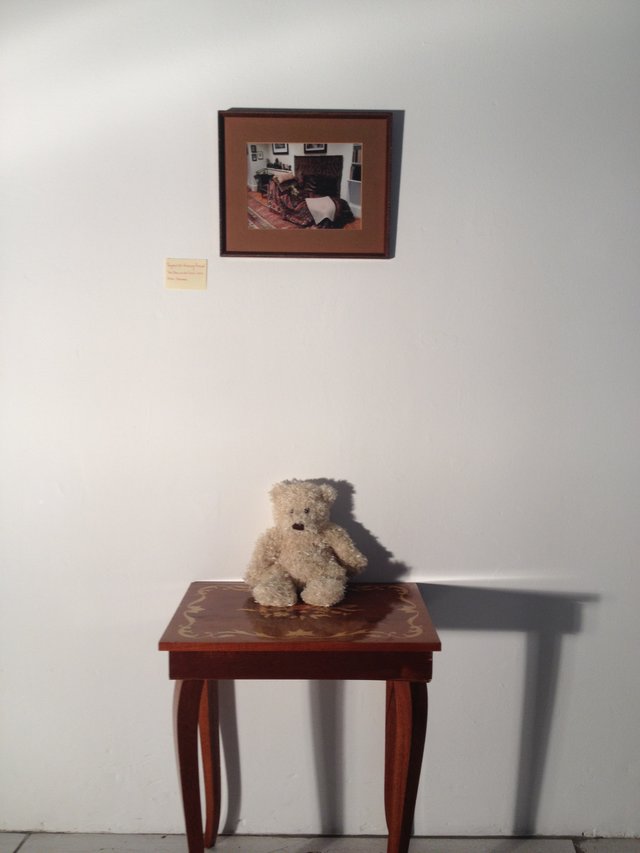 The Artefact “Beyond the archiving principle” presented at the C4CC (Centre for Creative Collaboration), London, 2013.
Bibliography
Barthes, R. (1993) Camera lucida : reflections on photography. London: Vintage.
Benjamin, W (1999) Illuminations: Unpacking my Library. London. Pimlico
Derrida, J. and Prenowitz, E. (tr.) (no date) Archive fever : a Freudian impression. Chicago: University of Chicago Press.
Freud, S. The Uncanny. An electronic version: http://web.mit.edu/allanmc/www/freud1.pdf
Freud, S. and Phillips, A. (ed.) (2006) The Penguin Freud reader. London: Penguin. (Penguin classics).
Links:
Derrida, J. Archive fever : a Freudian impression
Benjamin, W. Unpacking my Library
