

Performances
Writing & other encounters
Content types
Tags
- Plays (7)
- Warlike Collage (3)
- The Dybbuk (3)
- Twenty Two Pictures (3)
- Cheruta (3)
- Grace (3)
- Ruthie Osterman (2)
- Theatre du soleil (1)
- Arian Mnushkin (1)
- Iphigenia in Aulis (1)
- Euripides (1)
- Sophocles (1)
- Antigone (1)
- Performance Practices & Research (1)
- I am. I am. I am (1)
- ZSPERA'42 (1)
- Postal Delivery to God (1)
- Babylon Beyond Borders (1)
- Bush Theatre (1)
- Live Stream (1)
- Up Next (1)
Links
Links
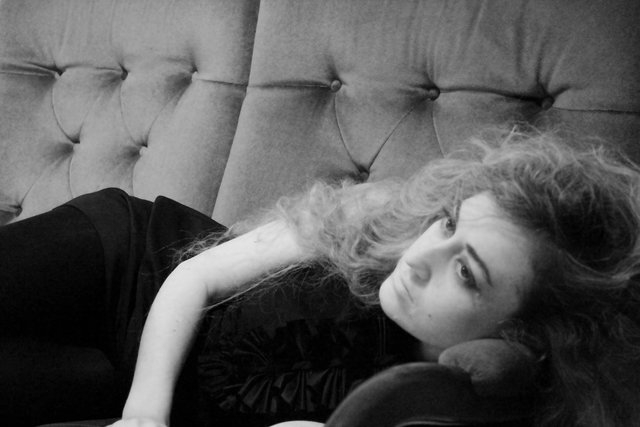
(Measure for Measure, William Shakespeare)
Twenty Two Pictures
Wins the best show in Acre Festival of Alternative Israeli Theater 2008.
Twenty and two pictures from the lives of three women: grandmother, mother and daughter.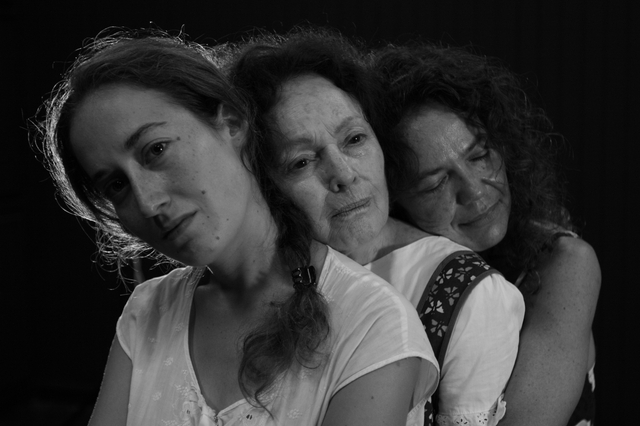
“A literary work, full of drama and humor which describes the world of a young girl, third generation of the Holocaust, who grows up in between two previous generations- grandmother, a Holocaust survivor, and her mother. In a segmental and theatrical language which includes the pain of growth and loss, the actresses succeed in exciting the audience and give them a deep and true experience.”
(From the judges’ reasons in choosing the winner show in Acre Festival 2008)
The play takes place in the ancient space of the halls of the knights inAcre, on the three levels of the space, which echo the three characters who take part in the play.
Grace
“Notzar” theatre, Bat-Yam, 2010
Writing and directing by Ruthie Osterman.
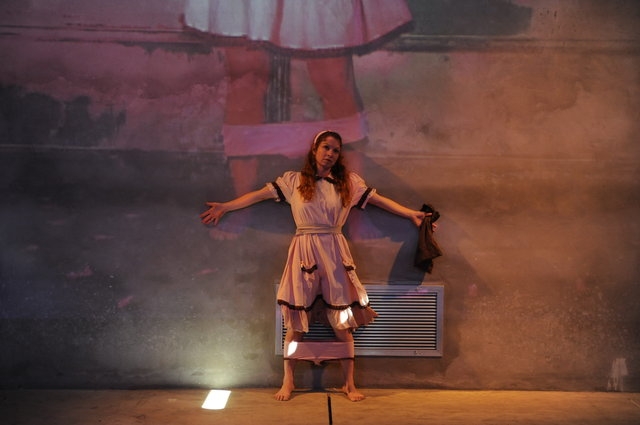
(from the play “Grace”)
The play tells the story of an encounter between a girl and an old woman on the railway tracks on the outskirts of town.
The woman has come to end her life on the tracks and thus gain longed-for peace, and the girl is there looking for the toffees that mark her way home.
For the woman, the railway tracks are a remnant of a childhood memory of abandonment, when her parents threw her from a train window during the war. For the girl, the tracks are where every night she meets a gang of children who abuse her.
The surprising encounter leads to a mutual reflection of the characters until it sometimes seems that they are one and the same. Out of the characters’ need for warmth and love, and their scratching each other’s wound, a brutal world replete with violence and fears, together with a desire for warmth, closeness, and a wish for reformation is revealed to the audience. At the end of the night the two go their separate ways, with each of them making a choice between life and death, and all that remains for them is the force of the human encounter with all that it brings to the surface and enables.
The play was inspired by documentary material dealing with violence and abuse in Israel.
SZPERA’42 – Site specific theatre event
Co- production Isreal – Poland, Lodz 2012.
Created By Tomasz Rodowicz & Ruthie Osterman
The performance “Szpera ’42” is dedicated to the events of September 1942 in Lodz Ghetto
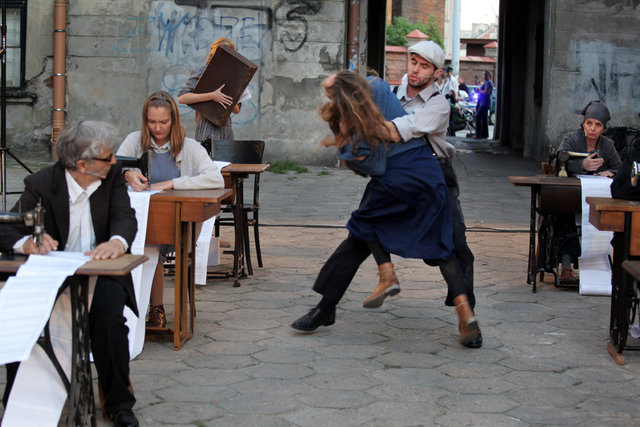
(Virginia Woolf)
The project is a site specific event, constructed as a journey to the places, stories and people from the Lodz Ghetto. Our purpose was to make an honest, contemporary dialogue with the ghetto, the places, stories, people, and the memory of the ghetto; the past connecting to the present, the daily life in this area, our life, and to find out what is really happening during this dialog.
It is a journey in which the audience walks between the original spaces in the ghetto, moves alongside the actors through various places in the ghetto, wartime original buildings which were transferred and which are now used for various purposes. Selected sites and buildings serve as “stations” during the journey, each place hosting a story connected to the site, through a “dialogue” with the space as it is today.
General explanation about Lodz Ghetto and the SZPERA
Writing & Directing
Ruthie Osterman, Tomasz Rodowicz
Actors
Joanna Chmielecka, Guy Zakh, Yoni Eilat, Łucja Herszkowicz, Ruthie Osterman, Tomasz Rodowicz,
Elina Toneva
Video Art
Yoav Cohen
Light and sound
Tomasz Krukowski
Music
Kuba Pałys
Collaboration and consultation
Joanna Podolska – “Dialogue Center”
Documentary film
Piotr Weychert
Video Parts from The Theatre project ” SZPERA’42” in this post ,were Photographed by:
Pola Amber
Stills images
Kamila Bogulewska
This post will be divided into two parts: in the first part, I will write on the process of and the rehearsal on the project “SZPERA’42” and in the second part I will write about the project itself, which took place on September2012 inLodz-Poland. Over the next year I will add a third part – the project inIsrael.
Part 1 :The creative process of SZPERA’42
The decision to create a theatrical work that engages The Lodz Ghetto and takes place in the original spaces, derives from my background. My grandmother was a Holocaust survivor. She was born in Lodz, and lived there between 1940-1944. She was exported from the ghetto to Auschwitz and then to a labor camp. My grandmother survived this terrible war with her two sisters. For most of my childhood and adolescent years – I grew up and lived with my grandmother. I was deeply attached to her. My grandmother’s past, her experiences and her stories, left me with an unforgettable impression, which shaped my identity.
At this point in my life, as a theater artist, I choose to make this fascinating, personal and professional journey in order to create a work that “will establish life” and will spark stories and memories of people, places and events from The Lodz Ghetto. I see this as my right and as a mission. This work is a journey through the intricacies of private and collective memory, through the road connecting past, present and future – within the boundaries of life and death.
I chose to create this project in collaboration with Polish producers, wishing to conduct a joint dialogue and recognize different points of view. Also, the hope to change the perception and learning from the past, to create a joint work of the present. In this choice, I’m running against the position of my grandmother, who due to her difficult experience and the horrors of war, felt deeply hurt and expressed anger towards the Polish people. I understand and respect her position, but fortunately, I am on different turf. I hope that my Polish friends and I are able to go into the sensitive recesses of memory, meet the stories, the places and the people in The Lodz Ghetto, and create out of this joint cooperation a work session with meaning and value
In December 2010 I first visited Lodz. I received a scholarship from the Polish Institute in Tel Aviv in cooperation with Adam Mickiewicz Institute in Poland. The purpose of my trip was to get acquainted with the places, to gather material for the future project, and especially to meet people from different fields who can help me with the project. Another central goal of my trip was to find partners that would like to collaborate in joint creation. This wonderful and meaningful visit left me with a strong impression that has upheld my wish to proceed with the project. Fortunately, I met wonderful people from different fields whom have offered me their help.
This visit led to a special meeting with the director Tomek Rodowicz and the “Chorea” group in Lodz, which I quickly understood, where ideal partners for the project. Tomek and the group hosted me kindly with generous heart. They have also expressed an interest and desire to cooperate with me. Together we toured the ghetto and learned about the places. At the end of my visit, Tomek and I decided, that we will try to do this project together.
From our first meeting, I felt that Tomek and I have something in common. I knew that it will be a unique experience to work with him and learn from him.
Tomek worked with Jerzy Grotowski for a long time and when I came to Lodz he had just made a performance based on Grotowski’s texts.
My first encounter withLodzwas shaking and powerful. It was winter 2010.Lodzwas Snowy and icy. I came on the Purpose of finding two things: the co-creator for my work and the grave of my great grandmother. I walked on the snowy streets ofLodz. Lodz for me was like “The Land of Oz” I had always known of its existence; its absence was present at every moment in my grandmother’s life, so getting to Lodz was like a journey to a lost land..
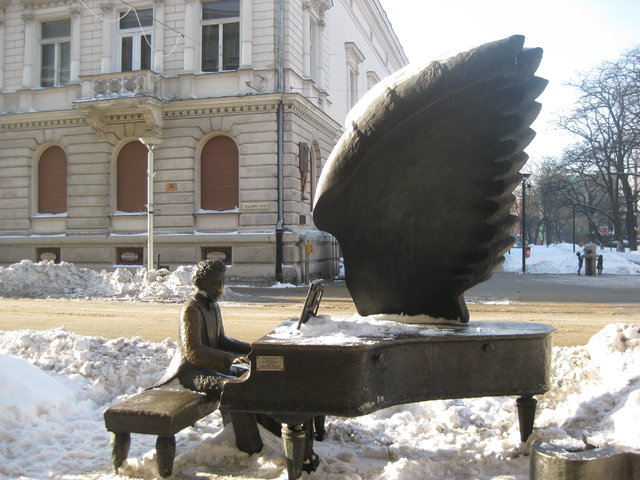 The monument of the pianist Arthur Rubinstein
After returning to Israel, during six months (between December 2010 – June 2011) I processed the materials and the experiences I had. I contacted the organization of Lodz’s survivals in Israel, interviewing survivors of The Lodz Ghetto. I have also read a lot of materials about The Lodz Ghetto. Following the above, I formulated an idea of the project in The Lodz Ghetto
In August 2011 I came back to Lodz, and together with Tomek Rodowicz we developed a common concept for the production, including the production needs, schedules and all establishments required for the project. I spend a month in Lodz in order to write and develop the materials in relation to the spaces in the ghetto. In this period of time Tomek and I had met Joanna Podolska, the Director of “Dialog Center in Lodz” and we decided to collaborate together in this project
That month in Lodz was very significant to the creative process. Most of the time, I wandered alone around Lodz or sat and wrote in cafes on Piotrkowska Street. I studied and felt Lodz. I tried all the time to check if I could hear the voices from the past in this place.
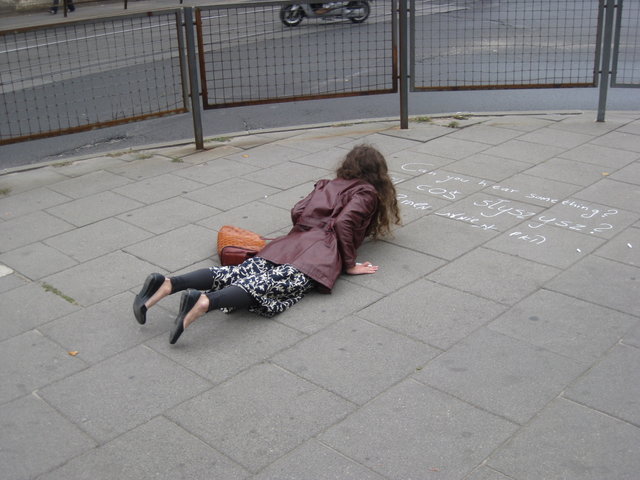
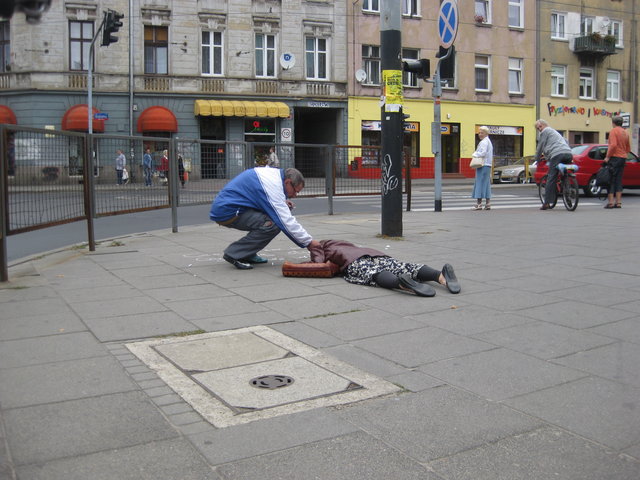
One day, with the help of Asia (a Polish actress), I went to the “Baluty”-the neighborhood where the ghetto had been – and wrote on the sidewalk the following question in three languages (Hebrew, Polish and English): “Can you hear something?”
I lay down on the sidewalk next to the words, exactly at the junction between the Church of Mary and Kościelny Square, in the place where the famous Bridge of Lodz ghetto had been. Waiting to see if I could hear something? Maybe someone else in the neighborhood might also hear something, might be able to answer my question.
Amazing how a simple action in space and time indicates the place where it occurs. Two minutes after writing on the sidewalk, an older man came up to me and patted me on the face, sure I was drunk. The First association of passer-bys was that I was drunk. Does this point to the problem of alcohol in Lodz? Does the fact that all the people who had approached me were adults mean something?
After seven minutes, the police came. They pushed me away with the explanation that “It’s a public space”. They asked me to show them my passport. When I answered “Israel” to their question “Where did you come from?” they said to each other in Polish “nerwowy”, not knowing that every time I made problems in my childhood, my mother and father told each other in Polish that I was “nerwowy”.
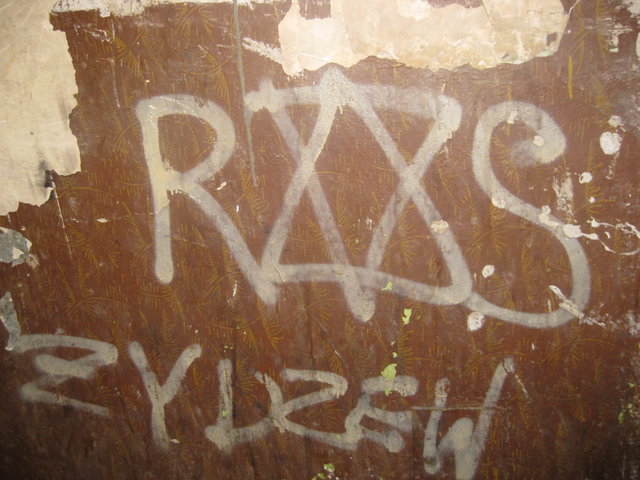
On the other side of the road, a group of young people in their twenties are standing and looking at me, drinking beer, laughing. It is the middle of the day and they have nothing to do. I go in their direction. I stop by them and listen to the wall they are leaning on. They tell me: “we know what you are doing; it’s because of the ghetto.” They take me to the building where they live, show me buildings from the Ghetto and explain to me the meaning of the graffiti that can be found all over Lodz of the letters R/T/S and a Star of David in the middle. This is how football clubs in Lodz call each other.
I ask “Why the Star of David?” They lie at first and then admit, “it is a curse, you know”.
One of them will tell me something that I take with me throughout all the process of working on this project: “I cannot hear the voices from the past because of the noise of empty beer bottles crashing on the sidewalks in this neighborhood.”
Lodz. Poland. Baluty. Ghetto. I slowly start making connections
After this visit to Poland, we get into another six months of intensive research about Lodz Ghetto: interviewing survivors, meeting people who are related to Lodz Ghetto and reading the “Chronicles of Lodz Ghetto”.
Tomek and I chose the places where we are going to work and the artists who will participate in the project.
On April 2012 we traveled to Poland for one month of rehearsals. With me are Yoav Cohen, a video artist, and Yoni Eilat , a Yiddish-speaking actor and singer.
During this month we performed on “Yom Hashoah” (the memorial day of the Holocaust ) with a small part of our project in front of 150 young Poles.
A short film about the rehearsal and the creative process in April 2012- Lodz, Poland (Made by Yoav Choen):
Reviews on the performance on “Yom Hashoa”
Part 2: “SZPERA’42” – The creation.
In August 2012 we arrive in Poland for the last rehearsals and perform three times: first in the Chorea Festival “RETRO/PER/SPECTIVE 2012”, second on the 29th August – the Memorial day of the liquidation of Lodz ghetto and third on the 4th of September – a special event for the 70th anniversary of the “Szpera” in Lodz Ghetto.
Rumkowski’s speech at Plac Strażacki
(14 Zachodnia St. Entrance from 13 Lutomierska St)
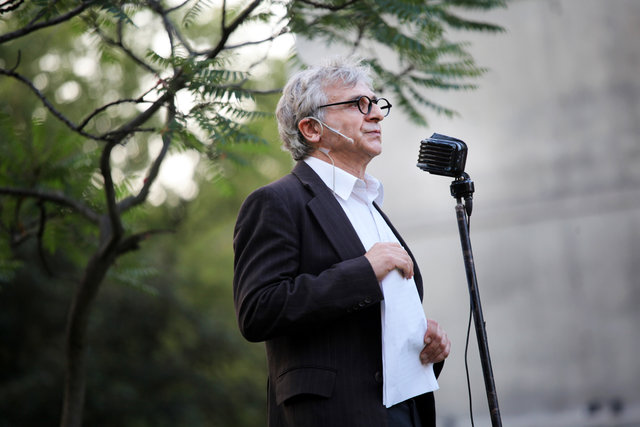
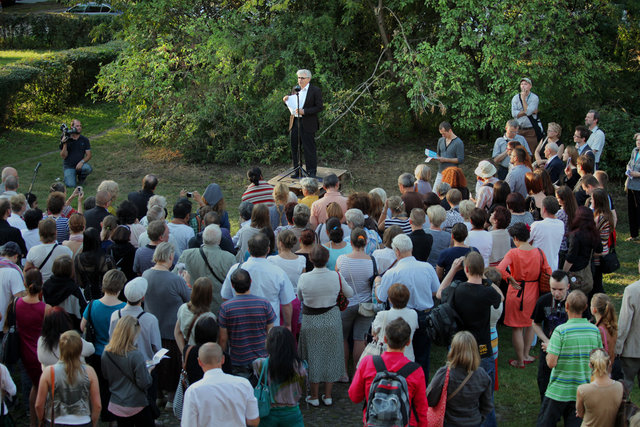
It is one of the least known and at the same time most important places in the Łódź ghetto. At 13 LutomierskaSt., the offi ces of the Jewish fi re brigade were located. At the back of the building, at a large square, there were the fi re brigade barracks with cars and equipment. It was there that Chaim Mordechai rumkowski, the Eldest of the Jews in the Łódź ghetto, gave his speeches. A podium with microphones and loudspeakers was placed there, so that rumkowski’s words could be heard everywhere.
The buildings at 13 Lutomierska St. no longer exist, replaced by blocks of fl ats. Only one of the houses survived (at 14 Zachodnia St.). It was in front of that building that rumkowski gave his famous speech in September 1942,asking the residents of the ghetto to give away their children so that others may be saved.
From rumkowski’s speech (4 September 1942):
(Speech by Chaim M. rumkowski, based on a translation from yiddish by Monika Polit )
At the first time we got to the place where Rumkowski spoke his famous speech, I was amazed to see that today there is a kindergarten there. The most famous sentence from Rumkowski’s speech is “Mothers Give me your children” and today, 70 years later, in the very same place there is a kindergarten. I often have the feeling that the past and present conduct an intensive dialogue between them and we only come with a beam of light to illuminate the dialogue that occurs anyway or put a microphone to hear it louder. We are basically a third party. The dialogue is going on with or without us. The kindergarten in this place is living proof of that.
Bridge over Zgierska Street
(by Kościelny Square)
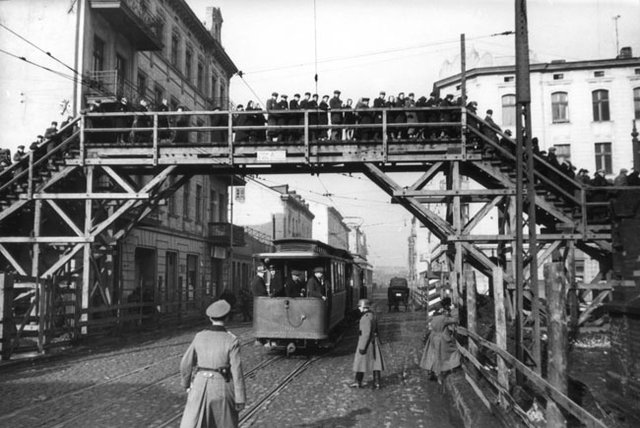
Two streets, Zgierska and Limanowskiego, were excluded from the ghetto and belonged to the Aryan part of Litzmannstadt. The ghetto, intersected by these two streets, was divided into three parts. At fi rst, at specific times, special gates were opened through which the residents could move from one section to the other.
In the summer of 1940, three wooden bridges were erected, connecting the divided parts of the ghetto and allowing people to cross over the streets.
(Arnold Mostowicz, With A Yellow Star And A Red Cross)
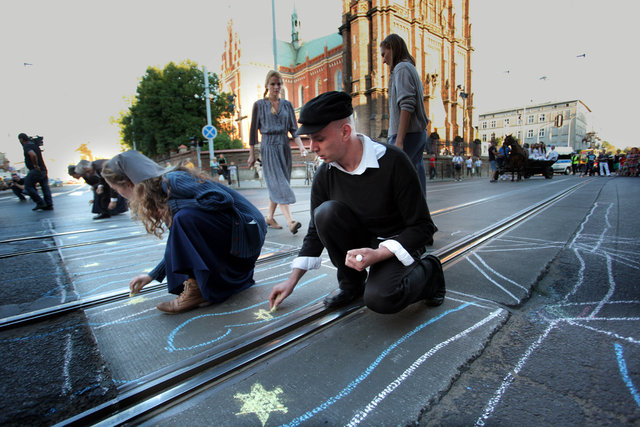
It was clear for us that we would want to commemorate the Bridge. This is the most famous image of Lodz Ghetto, located in a very central place and represents the separation of the Jews , their inability to walk on the road on Zgierska street and of course the prohibition to travel on the tram and maybe, in some kind of ironic way – their being “elevated”, “closer to sky”. During our rehearsals in April, I told the group that my grandmother’s favorite song was “The whole world is a narrow bridge and the main thing is not to fear at all”(words by Rabbi Nachman from Breslav and lyric by Naomi Shemer) I remember my grandmother singing it quietly and getting strength from it. When I told this to the group, Yoni Eilat naturally began to sing the song, his voice filling the hall of the church. It was a chilling moment. He then taught the group the song. During the performance, the Polish Choir accompanied us singing this song. The Bridge , as a metaphor of the world, merged with the bridge of Lodz Ghetto and the urge “Not to fear at all” took on new meaning.
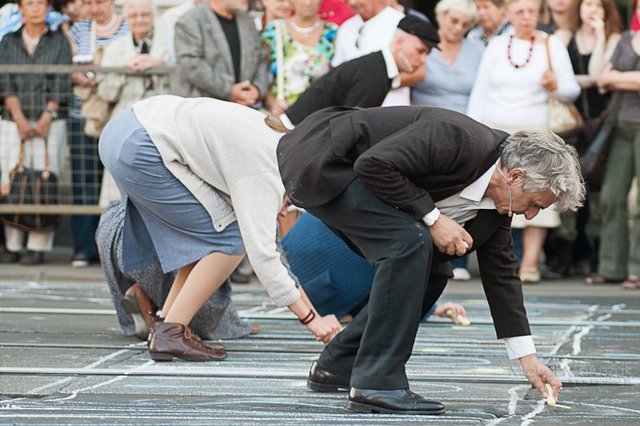
We decided to draw the bridge with white chalk. The chosen material was chalk because of its impermanence in the world and the obvious fact that it can be erased, perhaps because of rain, perhaps because cars and people pass over it and maybe due to time. Maybe like a memory that is always threatened by oblivion. And when something is physically erased, does it still exist in another dimension? A Spiritual dimension? In Consciousness? Questions about the existence of memory.
We knew we wanted our audience, Israelis and Polish alike, to cross our virtual bridge as an act of memory, out of respect for those Jews who crossed the bridge. We were amazed to see how out of 500 people who were at the event, there was not even one person who chose to cross the road not by our virtual bridge.
The bridge was drawn by Yoav Cohen, who practiced with us how to paint the bridge in a short time in various places in Poland..
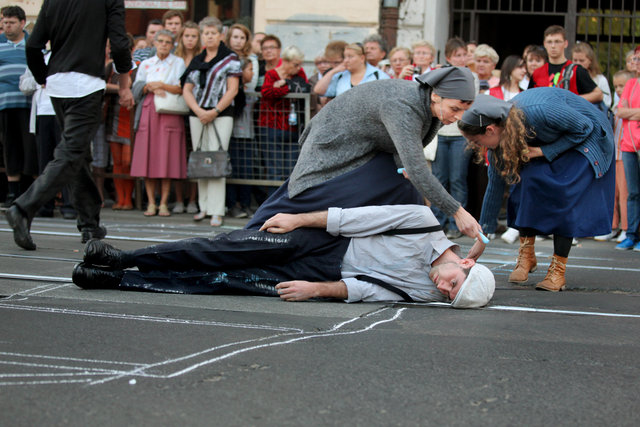
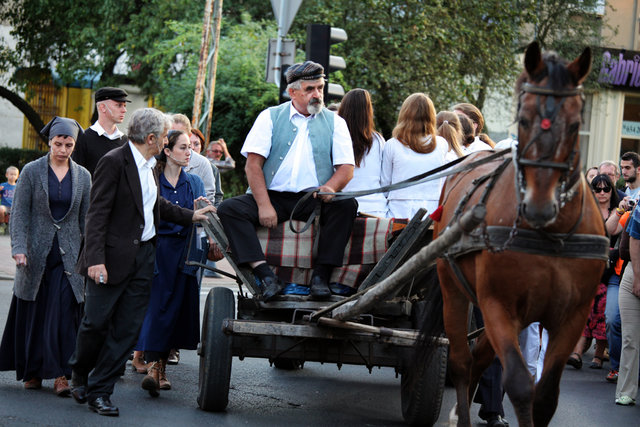
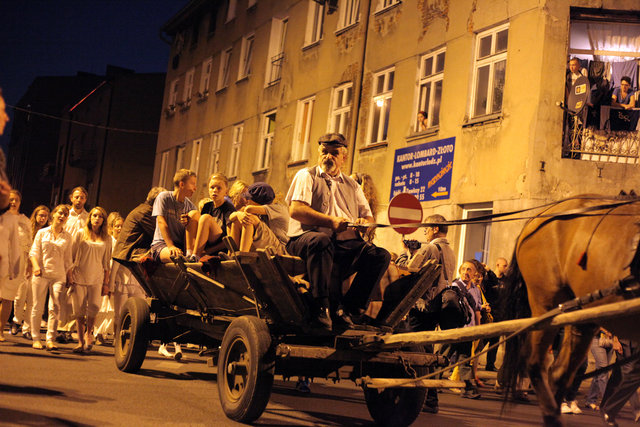
The creation was escorted by a horse and wagon. Asia (Polish actress) found them in a small village near her house and thanks to her, the journey was led by the wagon.
Wagon. You can write so much about “The Wagon”.. Itsac Shiffer, a Lodz survivor, once told me his dream was to have a wagon. He saw the ability to sit high above and move around as symbols of freedom and dignity; so that was a wagon for a child in the ghetto.
And from another point of view, during the” Zspera” ,anyone who was uploaded onto a wagon was taken to his death. Wagon meant death. I think of the respected grandparents of the survivor Abraham Zelig, ascending quietly, hand in hand, onto the wagon in the “Zspera” and taken to their death, of the children in the story of Yosef Zelikovitz, in his book “Those Worst Days “, children who for the first time in their lives were on a wagon. They want to laugh and rejoice being on the wagon, but the broken faces of their parents tell them it’s not time for laughter…
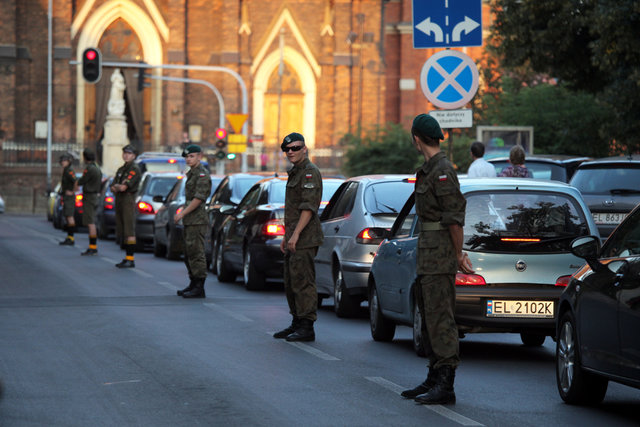
The Holy Virgin Mary Church
(Zgierska Steet)
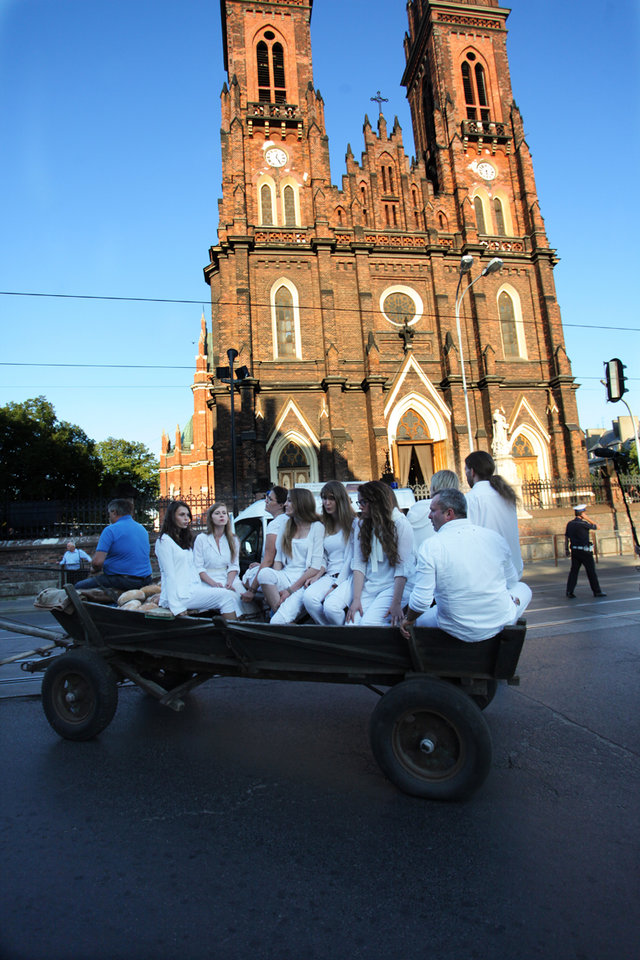
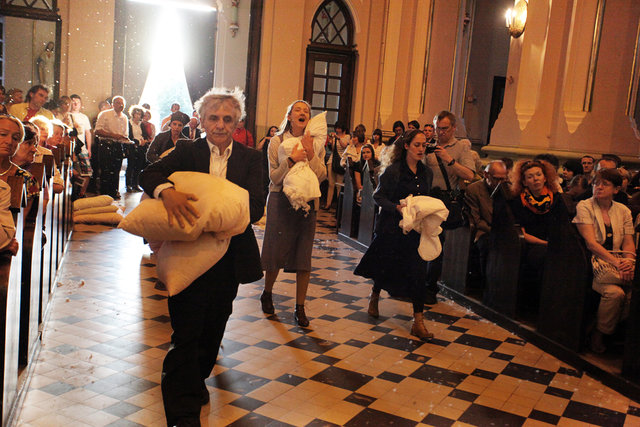
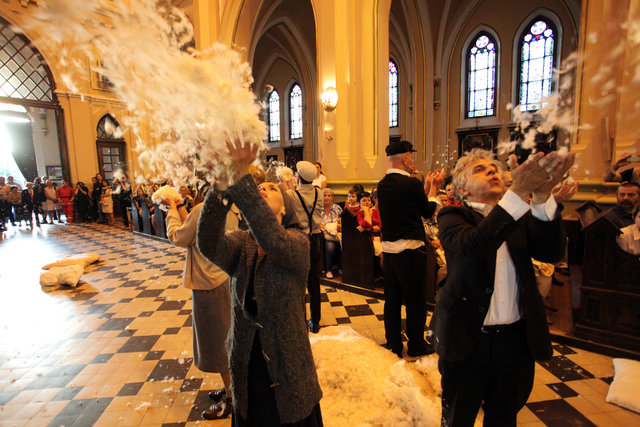
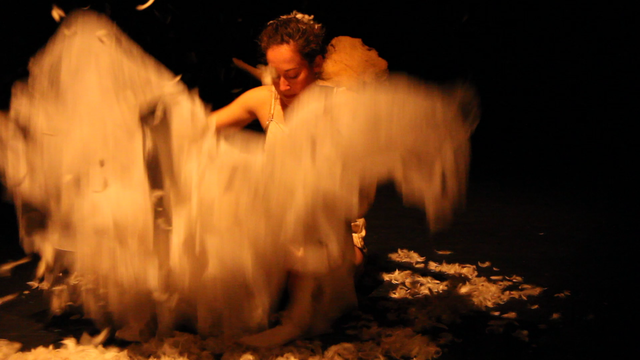
During World War Two,the Assumption of the Holy Virgin Mary Church was located within the Łódź ghetto. For thousands of Jews who had to move to the ghetto, the red brick church and the nerby wooden bridge over Zgierska Street were the most important symbols of the ghetto.In 1942, the Nazis decided to transform the church into a warehouse for storing stolen Jewish property. From spring to autumn 1942, clothes of people murdered in Chełmno on the Ner were brought there. Some people discovered the clothing of their loved ones who had been deported from the ghetto in an unknown direction.Then, inside the church, feather and down sorting was organized. The Jews called this place “white factory” and the Virgin Mary – the patron of the temple – Mary of the Down.
As part of my research, I met with Dr. Michal Unger, an expert on the Lodz ghetto. During a significant conversation with her in a cafe at the center of Tel – Aviv, I asked her: “If you had to make now a creation on Lodz ghetto, what places would you choose? What places come first into your mind? Two of her responses have become part of the work: the Church of Maria and the cultural house in the ghetto. She said that one of the strongest images from the Lodz ghetto is a picture of Mary Church full of feathers. During the war, the German turned the church to a store house for sorting objects of Jews sent to their deaths and most of the objects were blankets and pillows that were full of feathers..
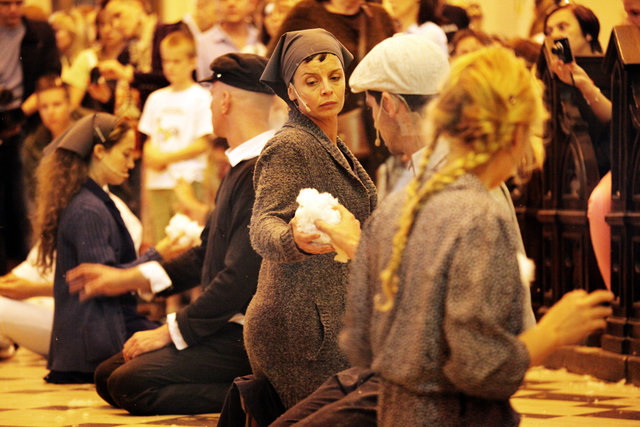
Indeed, we decided to work with pillows, blankets and feathers in the church and explore the topic of “dream” and “rest”, the privilege to lay my head on the pillow at the end of each day and rest, dream. We worked with the song “Dream” written by Abramek Koflovicz when he was 13 and which has been translated into many languages and composed for us by Ayala Asherov.
The Pillow, full of feathers, is the small sanctuary of the individual, full of soft and fragile material like feathers. The Memory, like the pillow, is a place to rest your head on and at the same time, flies easily and disappears.
I have to write about the priest Thomas. Priest. Central Church. Sunday Mass. And within each of these religious legal systems, we encounter a sensitive and open minded priest that allowed us to work inside the church, fill it with feathers, dance in it. Not obvious. Remarkable.
I tell him about the request of one of the survivors, who was very angry with me because I was cooperating with the Poles. “If they want us to believe that they are sorry for what happened, they should be ringing the church bells on the date of the “Zspera” so that all the people in Lodz will hear and remember”. And so it was. On the 4th of September 2012, at 18:00, at the beginning of our event, the priest Thomas rang the bells of the Church of Mary in honor of the Lodz survivors and in memory of those who did not survive. I am sure that the priest Thomas will be rewarded for it from the sky.
The Chronicle of the Łódź Ghetto
(4 Kościelny Square)
In the corner building at Zgierska St. “The Chronicle of the Lodz Ghetto” was created, one of the most important
documents of World War Two.
Chroniclers collected documents concerning the operation of the ghetto: announcements, posters and circulars
as well as rumkowski’s speeches and deportees’ documentation– their passports and personal letters.
Also here, at the Department of Statistics, worked the ghetto photographers and artists who created propaganda
materials, showing that the ghetto was useful. Many of these documents survived to this day and are
now found in the State Archive in Łódź.
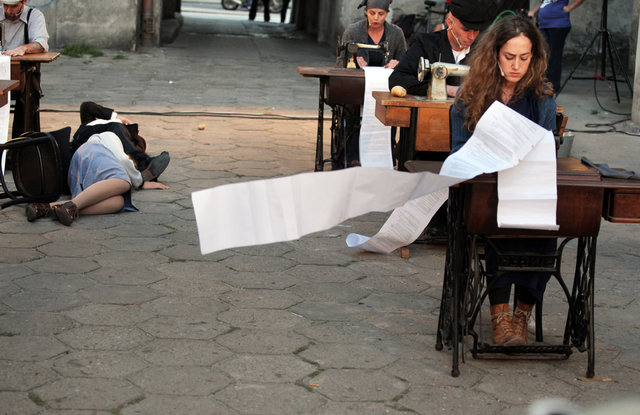
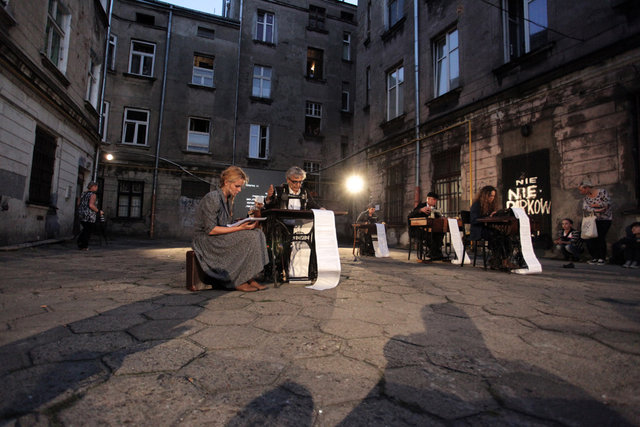
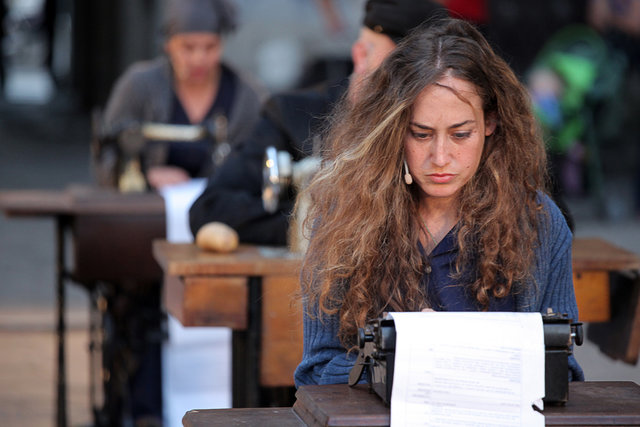
In a closet in my grandmother’s house, on a shelf, sat four thick books of a work called “Chronicles of the Lodz Ghetto Parts A-D”. These thick books always drew my eyes, but I did not know that twenty years later I would find myself sitting for days to read them all. I didn’t know I would find them a masterpiece documenting, in a most intriguing way, people’s survival, including what had happened in the ghetto each and every day: the weather, deaths and births, anecdotes and rumors of ghetto life and more. A document that for me was a rare documentary artistic text that became a theatrical one. In the courtyard of the building where the chronicles were written, we made theater work based entirely on texts from the chronicles
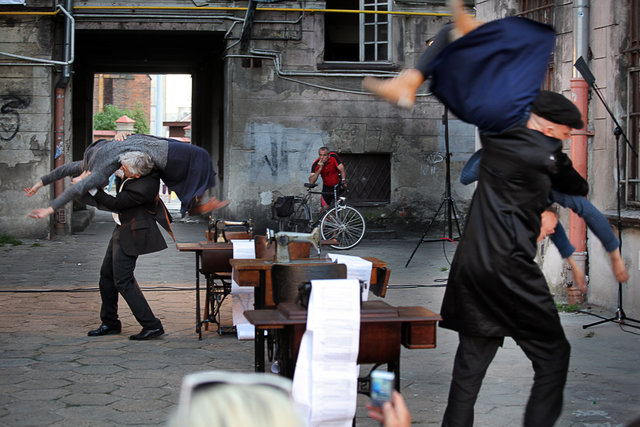
The main picture came that to mind was of resorts and establishments working in the Lodz ghetto, for example, sewing machines ordered one after the other. Anyone who is familiar with Lodz ghetto knows that it was a ghetto of work and anyone who wanted to survive – worked. My grandmother, until her last day, worked. There was no spare moment where you could see her sitting quietly, resting or simply having a good time; she worked non-stop and this “survival movement of working” could be felt every day at home. While working on this project, I got to know many more survivors from Lodz and I felt this “survival movement of working” in everyone. “Arbeit macht frei” is not just a sentence at the entrance to Auschwitz; I think that for the survivors of the Lodz ghetto, it is an existential condition of constant inner anxiety. It is hard for me to put this feeling into words, but I’m sure the second and third generation of Lodz survivors might know what I mean. Live and work are synonyms. ‘Parasite’ is the greatest curse. The Image of sewing machines ordered one after the other in the courtyard I saw had been in my mind from the beginning.
The typewriters are replaced by sewing machines and the text is sewn. Writing is work. A craft of Survival.
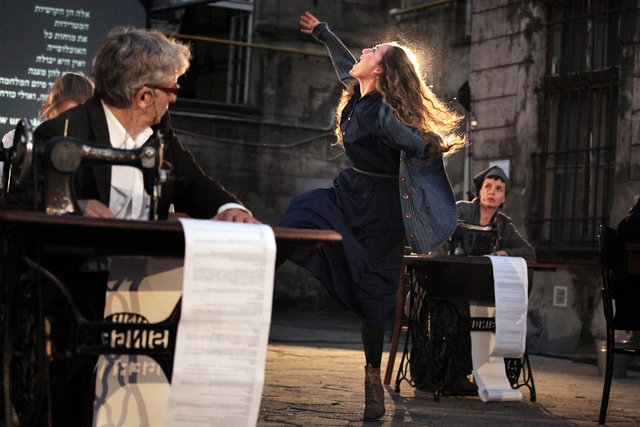
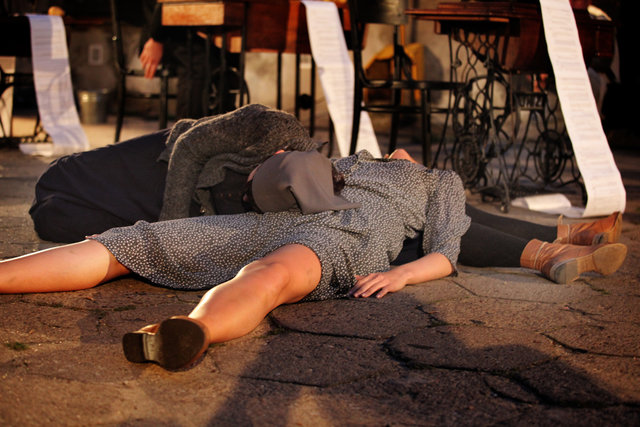
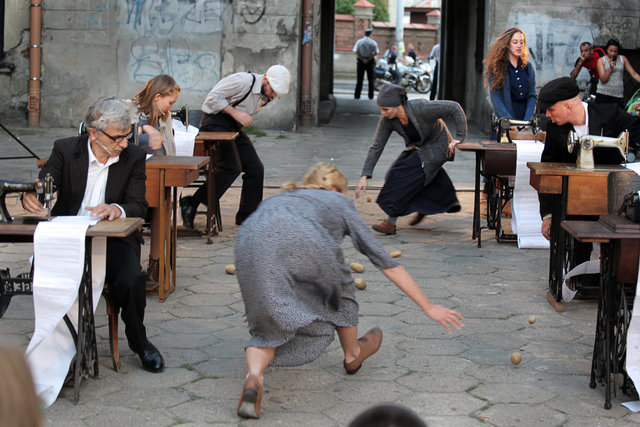
During our rehearsal in April 2012, on “Yom Hashoah”(the memorial day of the Holocaust) a strange event happened in Israel: during the show “ghetto” in the “Cameri Theater” some youths rioted and encouraged the actor who played the Nazi to hit the actor who played the Jew on stage. I don’t think I would have known about this ‘event’, had it not been published in the Polish media (or better to say “been celebrated” in the Polish media).
Tomek came to the rehearsals with a list of talkbacks, comments on the event, published on the internet and we were amazed by the reactions: some anti-Semitic , some expressing serious concern about the memory of the Holocaust, but all interesting and raising questions about the meaning of the Holocaust today. We found that the Israelis’ responses on the internet were equally interesting and decided together to add a “Part II” to the chronicles – “Comments of Israeli and Polish talkbacks about the event that happened on “Yom Hashoah”. The typewriter was replaced by a laptop and we quoted the comments. Maybe we should say the “chronicles” of Today.
To the article about the interruption of the youth on “Yom Hashoah”
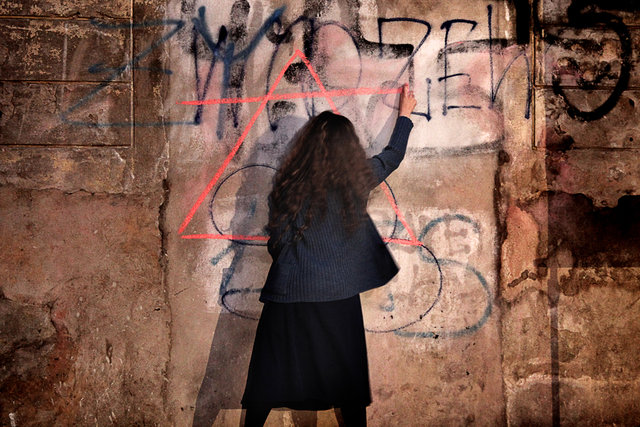
Star of David Graffiti
I have to write about the Star of David that is scattered across Lodz. I havea full stomach but I’ll be brief. From the moment I landed in Lodz and asked nervously “What is this?” everyone tried, each in his own way, to explain to me how it’s meaningless. That the youths who draw the graffiti are hooligans who do not understand what they are doing and have no idea what a Jew is. True. True and false.
Explanation for those who do not know: In Lodz, football clubs call each other by the derogatory name: Jews
The simple fact is that a Jew is still a curse. Indeed, it is a curse of uneducated people, used in the context of a football game, but still a Jew = curse. The Star of David, which no one knows what it means = something bad, despising.
To mention that the Nazi Party began with a small group of hooligans and not with the higher education in Germany will be the beginning of unnecessary history lesson. Here emerge primarily questions of “the assimilation of hatred”, the meaning of the symbol and the symbolic, social codes and even aesthetic questions.
I told Tomek that I’m going to paint this graffiti in our show on the wall of the chronicles building. He agreed only because he did not want to mess with the “Mad Jewess girl”. We did not know what it will create. After the first performance in April 2012, someone came up to me and said “It was a slap on the face”.
On Chorea’s Festival “RETRO-PER-SPECTIVE” on summer 2012 they chose to use the following poster as the publication to our show:
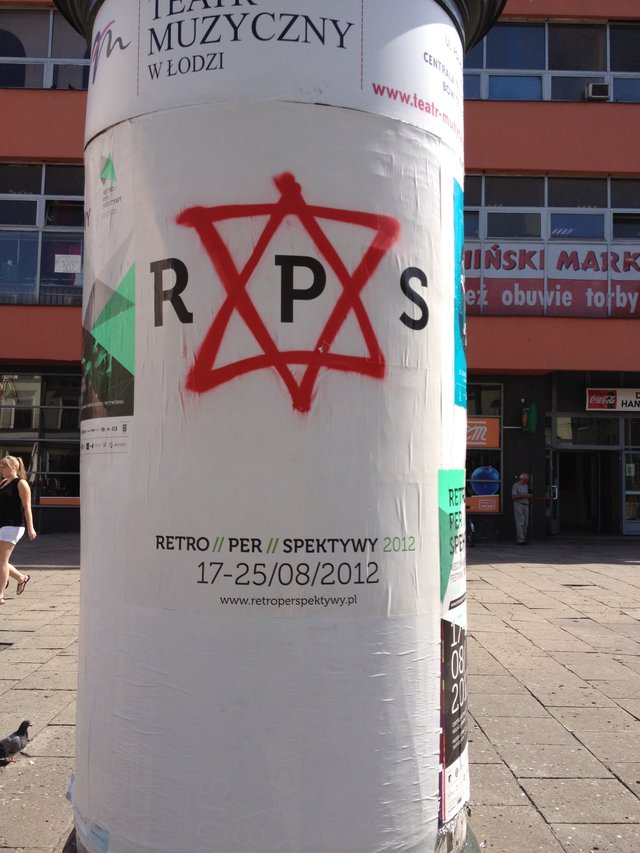
I don’t know what it means; but it means something. Today, Lodz 2012 and particularly the Baluti neighborhood is full of this graffiti. And as my teacher, the actress Libya Hachmon, said during a visit of the Poles in Israel: “hate without understanding is more severe; it means it’s deep and embedded. Hate for no specific face – anyone can be included in the equation.”
The Courtyard at 16 Wojska Polskiego Street
And the work with children in the neighborhood
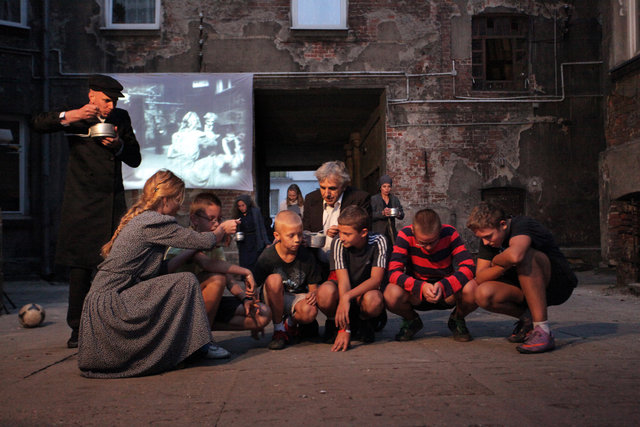
During the tour we did in “Baluti” we entered a courtyard and suddenly felt we were in a Holocaust film set. Everything looked so real and authentic. We were in the ghetto. Just a yard, without any particular role or historical building, a courtyard surrounded by houses which had been inhabited by Jews. And probably so many things have happened here. We knew that we wanted to work here. We looked around this courtyard, not knowing what we were doing, watching, wondering. Only us, the place and a group of children playing football. In time I will find out that the football has become a symbol for me, because of the graffiti of the Star of David , because of the hidden anti-Semitism in this sport. I went to the children along with Asia (Polish actress) who translated the conversation and we had the following dialogue
(which you can see in the video of our rehearsal process)
Ruthie: Do you know what was here before?
Children: Yes, the ghetto and all that. Killed Jews.
Ruthie: Jew is good or bad?
Child: (Laughing) bad.
Ruthie: Why?
Child: (Laughing) I do not know (laughing)
Ruthie: Well, first of all, I’m from Israel. I’m Jewish.
Children: (Laughing)
Ruthie: And now let’s play football together.
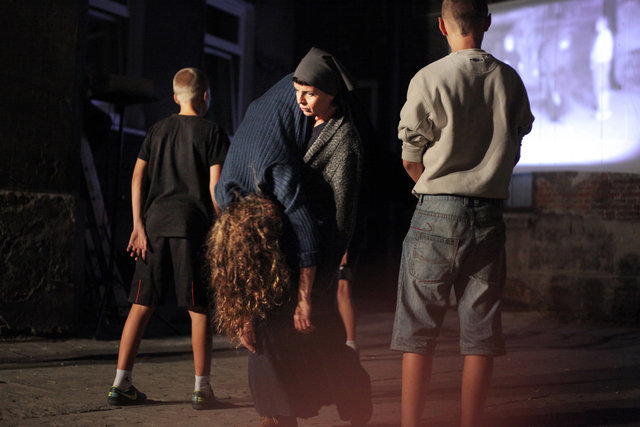
From our football game with the children, the scene in the courtyard in Walska Pulzkeigo 16 has emerged. The children playing football and Yoav, the video artist, photographs them live. As soon as he whistles they stop playing and we, the performers, enter the scene with some physical work inspired by chosen stills pictures from the ghetto (e.g. carrying bodies, eating, hiding, etc.) Once we enter the scene with the children, the video image becomes black and white, with the qualities of an old movie, as we remember, or used to seeing movies from the ghetto. Present and past merge one with the other. Once we leave the area, the children continue to play football. Every time we enter the scene – we affect it in some way (e.g. leave an old hat on the head of one of the children, take a child with us and finally leave a body in the “football field” and the children continue to play while it is there).
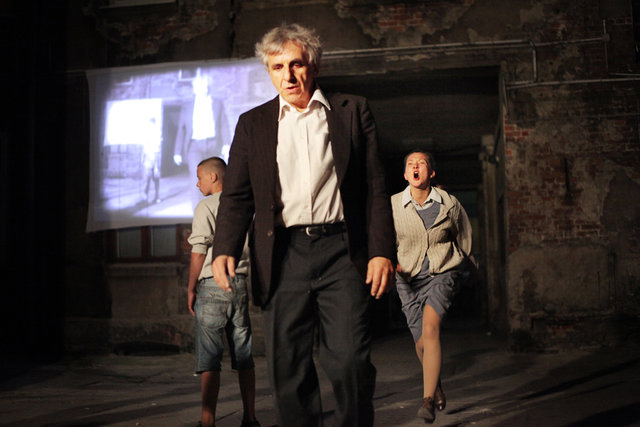
This is one of the most significant scenes for me. For Tomek and for me it was very important to involve the people living in this neighborhood in this artwork, which is really what had happened with these kids. From choosing the children, rehearsing with them, meeting their parents, till the event itself. I’m not naive to think that next time they are asked whether a Jew is good or bad they’ll say good. But I think that on many layers it was a significant encounter for all of us.
The Culture House
3 Krawiecka Street
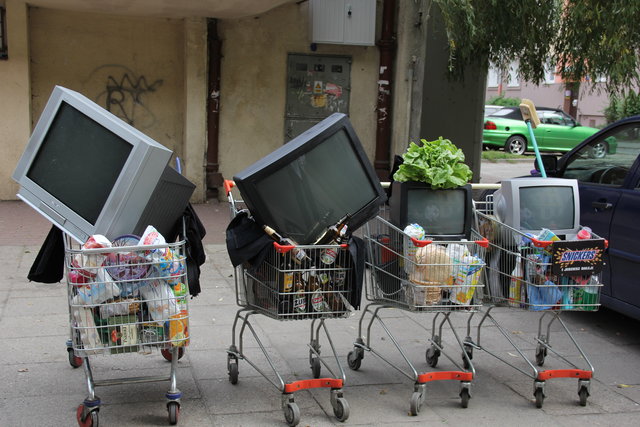
It is hard to believe that this small building, where today a local shop is located, used to be a cinema. The auditorium held 400 seats and a stage, where both symphony orchestra and theater troupes could perform. This was the center of the ghetto cultural life: concerts, theater performances, exhibitions and poetry readings. The house of culture offi cially opened on March 1, 1941, although theater performances and concerts had been held there before. The residents of the ghetto attended both classical music concerts and light entertainment shows. In the fi rst year, revue performances were staged 85 times. The troupe consisted of prominent pre-war Jewish artists, including Moshe Puławer and róża Bloch, the orchestra was by conducted by Dawid Bajgelman, decorations were prepared by Pinchas Schwarz. After transports from Prague, Berlin and Vienna arrived at Litzmannstadt, world-famous virtuosos performed there, along with children from orphanages. After “wielka szpera”, cultural life in the ghetto practically ceased to exist. Germans deported many artists to Chełmno. In the summer of 1943, the building was converted into a department of quilts and blankets.
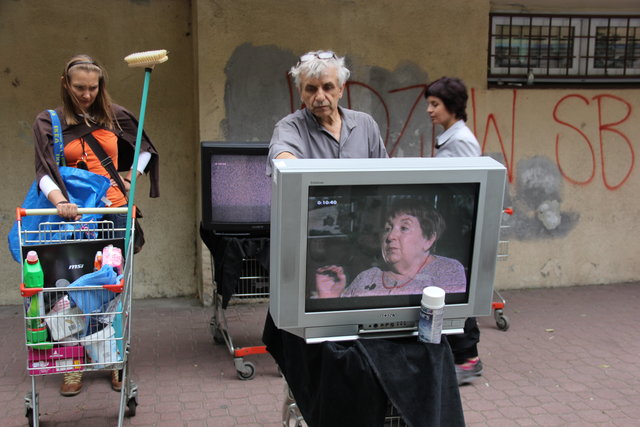
In the Building where the “culture house” used to be, there is now a Super Market. Ironically, this raises interesting questions about culture and “consumers’ culture”, about the relationship between food and culture. I remember a history lesson on “rebellion and heroism”, which spoke not only about physical uprising like that of the Warsaw ghetto, but the “choosing of life”, the uprising of the human spirit – choosing culture, faith, friendship, keeping one’s ethics and morals in impossible conditions. For me, the “Culture House” in Lodz ghetto is one of the most unique examples of the “Choosing of life”.
When I met Dr. Michal Unger, she told me about an incident that happened in the “Culture House” in which a singer sang a song called “Close Your Little Eyes”, written by Yeshayahu Spiegel in Yiddish and composed by David Beigelman. In the song Spiegel is talking about his little daughter.
The lyrics translated into English:
Soon little birds will fly
In circles everywhere.
They’ll flutter by your bed.
Your head upon your hand,
The house in ash and sand!
We leave, my darling child,
In search of life…
Gods from the world withdrawn,
The black night fills each dawn,
She waits for us
With horror and with dread,
With terror always near,
Not knowing where, oh where
Our road has led.
Stripped naked, we were thrown,
Chased from our loving home,
In darkest night
Into the open field.
In wind and hail and storm,
By fearsome currents borne,
Borne forth into the depths
Of the earth”
On hearing the song, the crowd began to cry and Rumkowski, who sat in the front row, was furious and demanded to know who had written the song and brought more sadness to the ghetto. He wanted to send Yeshayahu Spiegel to Chelmno.
Due to associates who spoke of Spiegel’s rights, he remained in the ghetto.
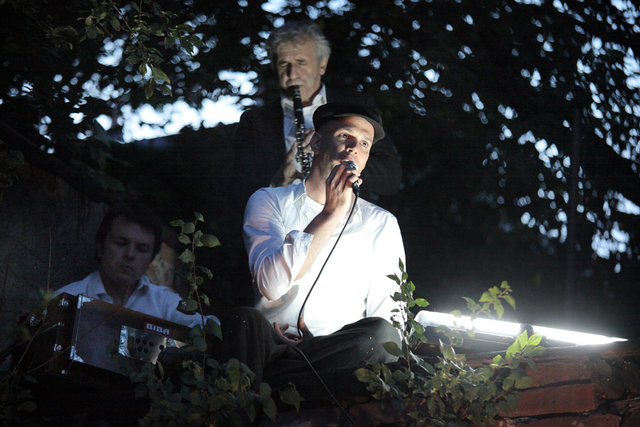
In memory and honor of these people, we decided to sing the song “Close Your Little Eyes” in the culture house. Yoni Eilat sings in Yiddish and Cuba Pałys plays the harmonica:
Listen to the song “Close Your Little Eyes”
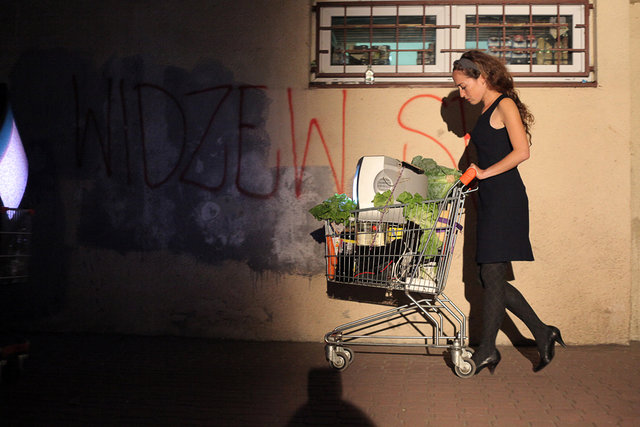
In the “culture house” we used testimonies of survivors from the Lodz ghetto and projected them on televisions in supermarket trolleys. In this scene we asked ourselves questions such as: What do these testimonies mean for us today? Do we or don’t we want to hear these testimonies? Are they part of what we “consume” in the Polish and Israeli cultures and what we do with them?
The Hospital
36 Łagiewnicka Street
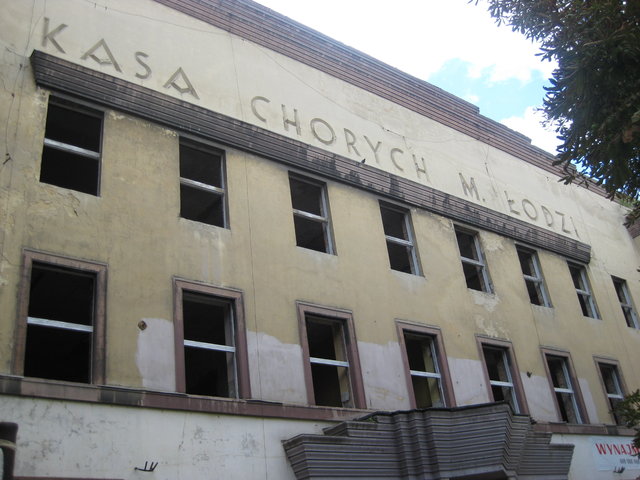
The hospital building was completed and opened just before the war. It was one housed the Department of Health created by rumkowski and Hospital No. 1. In one of the wings, there was the private apartment of the Eldest of the Jews in the ghetto. until September 1942, health care in the ghetto functioned more or less normally. Patients were examined (including lung x-rays), prescriptions were written, although the most common documents issued were death certifi cates. It was only during the September “szpera” that all hospitals were closed down. It was done in a very brutal way. The most dramatic events occurred at the hospital at Łagiewnicka St. The Germans deported all the sick to Chełmno on the Ner. The point of assembly for people selected for the deportation from the ghetto was located here. On the other side, at 37 Łagiewnicka St., a hospital for children was located. During “szpera”, it was a place where children of dignitaries, high-ranking offi cials of the Jewish administration and the police were hidden from deportations.
One of the places that was the most difficult to work with. The testimonies of survivors that the Nazis threw the sick from the windows of this building during the Zspera shocked us. What can we do in this terrible place? The open, gaping windows looked wide-eyed watching us, or like black holes to an unknown place.
During the process of the rehearsals, we got permission from the landlord to enter and work inside the house – a long and complicated process of contacting the landlord began with our attempts to enter the building and ended with our receiving approval to work in it. Eventually, we even performed there on “Yom Hashoah” 2012. However, for the event in the summer, the landlord didn’t let us enter the building, which was under construction, without a permit and we decided to use the building from its external side only.
The choir sang the song of Rabbi Shlomo Carlibach with words from the Psalms “Even though I walk in the valley of the shadow of death, I will not fear evil because you are with me”. We stood outside staring into the empty windows.
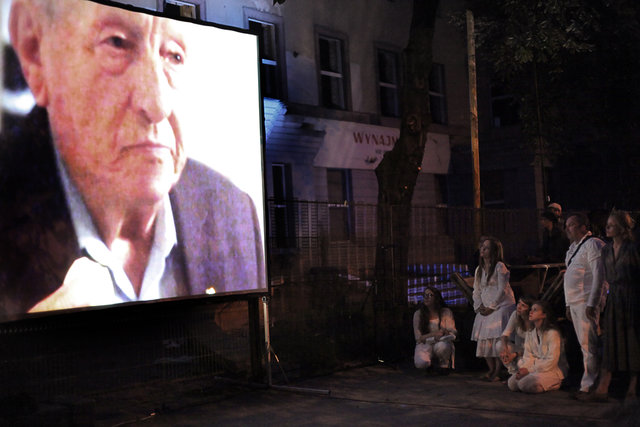
Finally, we screened a film of Lodz survivors dancing, a film we had shot in July 2012 in a very special building in the center of Tel – Aviv called “The Lodzia house”. The dance of the survivors is a symbol and call for life and living. The survivors’ ball.
This was the first part of the project, located in Lodz – Poland.
During 2013, we will bring the project to Israel. Currently we are looking for appropriate and proper way to do the project in Israel. We intend to integrate Lodz survivors in performance.
With the support of:








Acknowledgments: Organization of former residents of Lodz in Isreal, Lodz survivors, Uri Weizenberg,Zlila Bourkay, Zvia Frid, Dr.Michal Unger, Pawell Spodenkiewicz,Arie Rozen,Nir Turk, Chorea members, Stage Center.
Reviews
I am. I am. I am.
Royal Central School of Speech & Drama, London , 2013
Intermedial Performance by Ruthie Osterman.
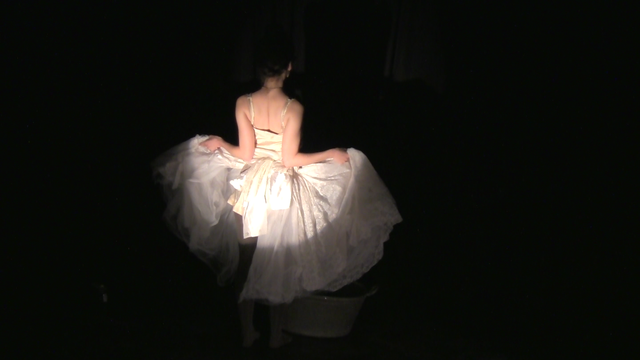
“I took a deep breath and listened to the old brag of my heart. I am, I am, I am.”
(Sylvia Plath, The Bell Jar)
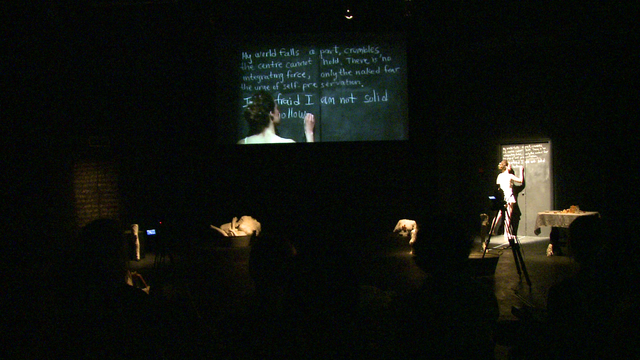
This intermedial performance practice explores the encounter between body, image and object.
A point of friction between the mortal and the immortal.
In a fragile world full of memories, images, texts and movements, one self appears and disappears, born and vanishing again.
A negative of something which is never known.
I prayed to God to wake up in the morning, even though I had never gone to sleep.

Created and performed by:
Ruthie Osterman
Artistic consultant & tutoring:
Dr. Experience Bryon, Jo Scott, Jessica Hartley.
Media consultant
Ken Mizutani and Roberto Puzone.
Lighting design
Phil Rowe
Texts
From “The Unnamable” by Samuel Beckett & “The unabridged journals of Sylvia Plath”
Music
“Shine on you crazy diamond” / Pink Floyd
Video operator
Reut Wizenberg.
Light operator
Hedda S.Rui.
Performing “The other hand”
Joao Telmo.
About the practice
This intermedial performance-practice was created as part of my MA studies in Performance Practices & Research at the Royal Central School of Speech & Drama and presented as part of the Brink Festival in June 2013. In my Practice as Research project I explored the relationship between intermediality and the subject matter of memory in a Live performance. Beside my artistic knowledge and experience as a theatre director and a performer, I was exploring a new field of intermediality in performance: “the meeting point in-between the performers, the observers, and the confluence of media involved in a performance at a particular moment in time. The intermedial inhabits a space in-between the different realities that the performance creates.”(Chapple & Kattenbelt 2006:12)
As part of my research, I applied the philosophical concepts of Henri Bergson’s Memory and of Jacques Derrida’s différance as a lense through which I asked creative questions and constructed the work.
The intermedial performance “I am. I am. I am.” constituted the practical part of my Practice as Research project and is accompanied by a thesis which I wrote as part of my MA studies.
“What might have been and what has been
Point to one end, which is always present.
Footfalls echo in the memory
Down the passage which we did not take
Towards the door we never opened…” (T.S. Eliot, Four Quartets)
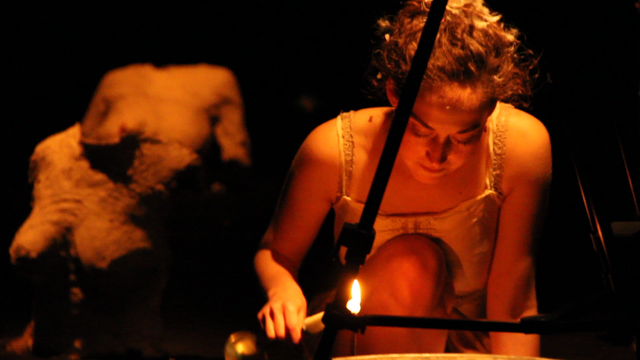
About the performance:
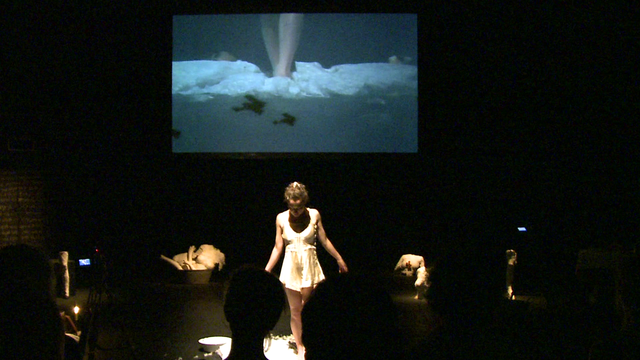
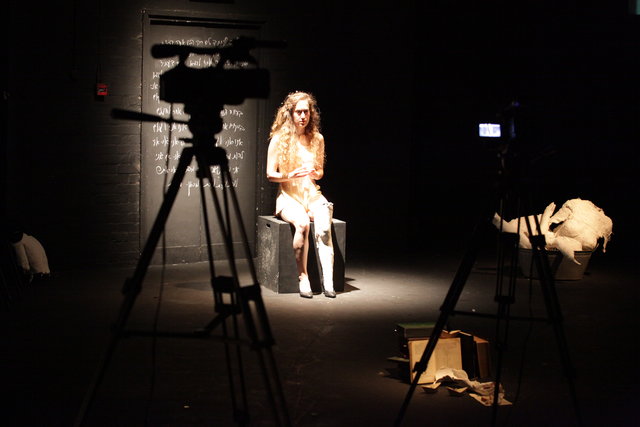
I performed on stage with different objects, four live cameras, a projector and a big screen hanging from the ceiling. The performance’s theme was memory and identity and it was composed from different elements related to my identity. The audience was located in front of the stage. I used the software Modul8, a vision mixer connected to a computer and the projector in order to project the live and the pre-recorded images on the screen and create the combination between them. The software was operated live during the performance by a technical operator.
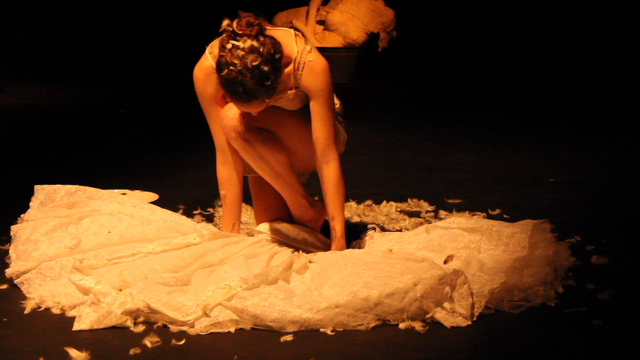
Creating the Intermedial-Encounter – A glimpse into the creative process:
Content (Memory, Tradition and Nature)
I have drawn my practice from the contents of my memories, traditional and historical heritage and nature and chose particular forms of objects, images and my body to represent these in performance.
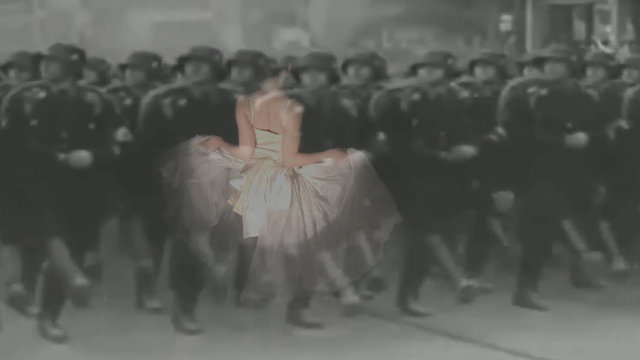
In my practice, my memory constitutes the main source with which I had entered the studio. The virtual pasts were actualized in my practice and co-existed with the present action. Examples of such memories are my fear from the Nazis’ steps I used to imagine I heard as a child and the bread my grandmother used to feed me.
An additional kind of content was symbols and rituals from my Jewish religious tradition , such as Netilat Yadaym – the act of washing the hands before eating bread, salting the bread during the Kiddush ceremony on Shabbat and the Caparot ritual – a ritual for cleansing your guilt by spinning a chicken over your head and praying that your blame be transferred to the animal.
The third content was elements from nature. While the first two kinds of contents came directly from my inner world, the third one came from the external world. I mainly used materials from nature such as water, fire, salt and feather. The chosen rituals relate to change in their traditional value and take place in order to move from one state to another. I took them out of their context and placed them in relation to other elements in order to create an ‘in-between’ tension. I chose to use very simple and old elements beside the modern and complex media equipment; in this way I composed an intermedial encounter from variety of ‘in-betweens’.
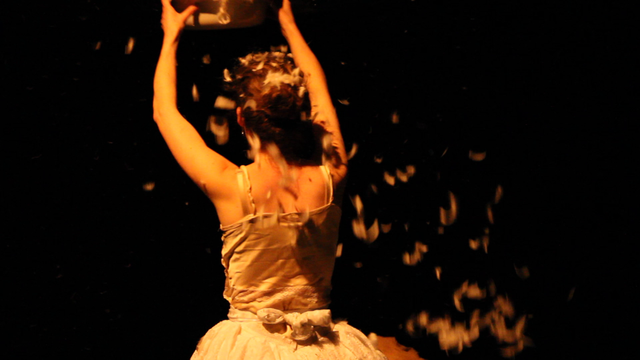
Forms (object, image and body)
Object
The objects which I used ‘came to me’; they emerged from memories or were found by chance. An example of such an object is the bowl I used in my performance. On May 2013, I visited the props-warehouse in Central school of speech and Drama, which is a small room full of junk, and by chance I found two old metal bowls that attracted me. Only when I got to the studio I realized that one of the metal bowls had an engraving of the Star of David at its bottom. It was very surprising and even shocking; how did this bowl get here?
My initial purpose for using a bowl came from my childhood memory in a bath; but the object I found evoked something else. I suddenly realized why it seemed familiar. I saw these kinds of bowls in Atlit detainee camp in Israel. The object connected my private memory to the historical/collective memory of my nation and a new encounter emerged.
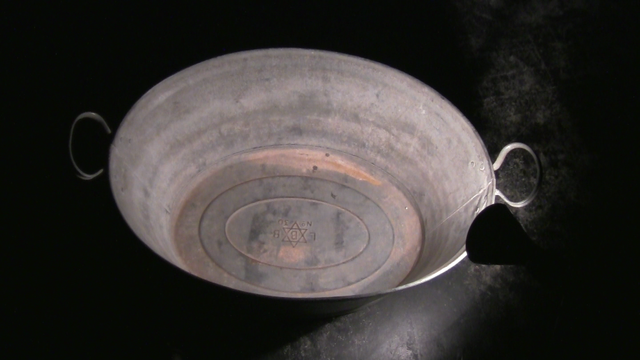
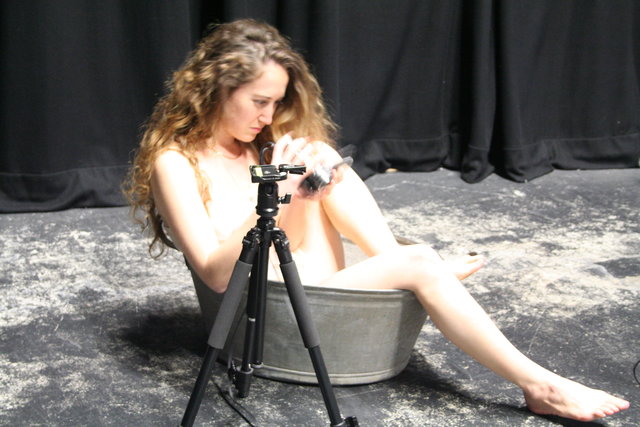
Photos taken from the rehearsal of “I am. I am. I am.” , Experimental-studio, CSSD.
Beyond the function of an object in activating memory, it has a significant role in creating the ‘in-between’ of the intermedial encounter. The object functioned as an actual form beside its virtual image (For example, the bread on the table and its close-up on the screen) and as an actual form beside the actual body (the torso-cast of my body and my live body). The unique objects of my body-casts aimed to empower the encounter between the three forms which allegedly represent the same identity and fragmentation of identity.
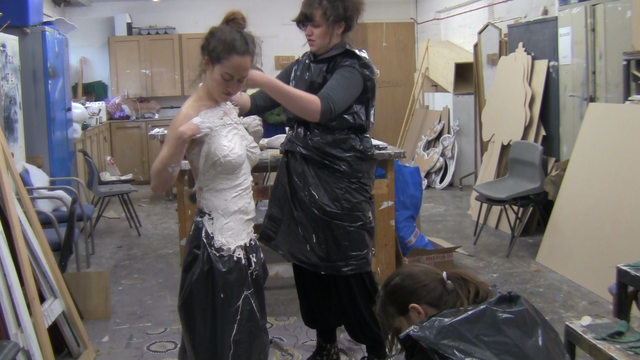
Photo taken from the process of creating the body-cast.
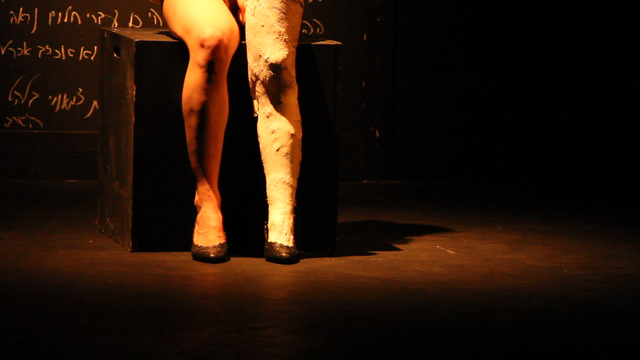
Photo taken of using one of the body-cast in the performance.
Image
There are three main kinds of images which I created and explored in my practice:
1. Pre- recorded image
I used pre-recorded images which emerged from my memory and represented different dimensions and times than those that existed on stage. What guided me in choosing these pre-recorded images was the notion of correspondence. The pre-recorded images co-responded to something which existed in the present moment on stage and created the tension of the ‘in-between’. My exploration of the co-existence of a virtual image of the past and an actual action in the present on stage is based on the Bergsonian concept of the co-existence of past and present.
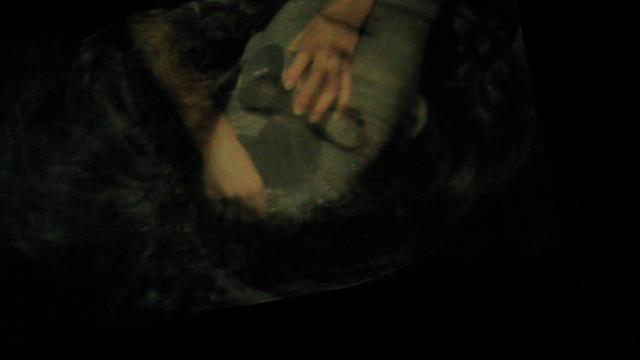
2. Live image – I created live images from the actions happening on stage. The actions and the frames had been chosen carefully from the materials which emerged in the rehearsal and which had been composed for stage. I aimed to strengthen the tension and the differentiation between the actual action and its virtual form by playing with proximity and distance, exposure and hiding. By using live images and not only pre-recorded materials I revealed the differentiation within the live moment. It is not only a tension between different temporalities (like past and present) but also within the present moment itself.
3. Two-layers image – a combination of a pre-recorded image and the live image
The combination of two images together and the dissolving between different times and spaces within one image. Following Derrida’s différance, I tried to see to it that each element will keep ‘within itself the mark of the past element’ and ‘letting itself be vitiated by the mark of its relation to the future element’ (Derrida 1991:65). Therefore I created complex images which had been marked by different times.
Body
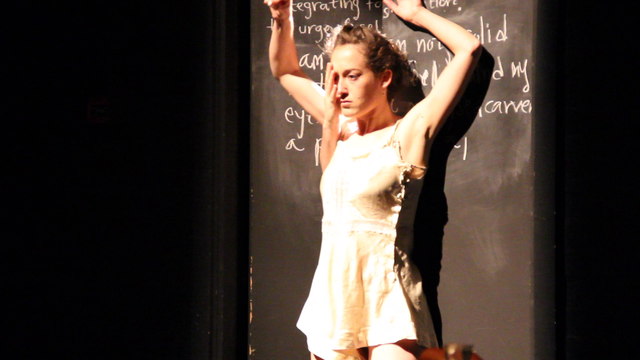
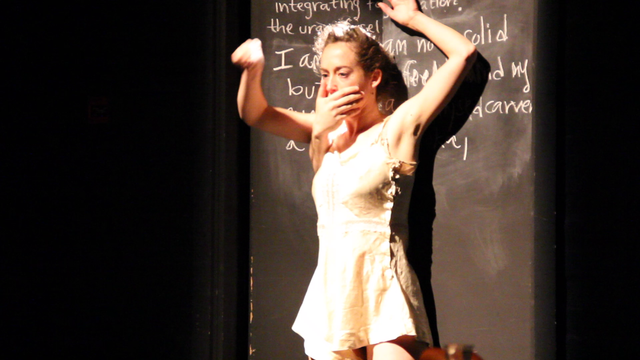
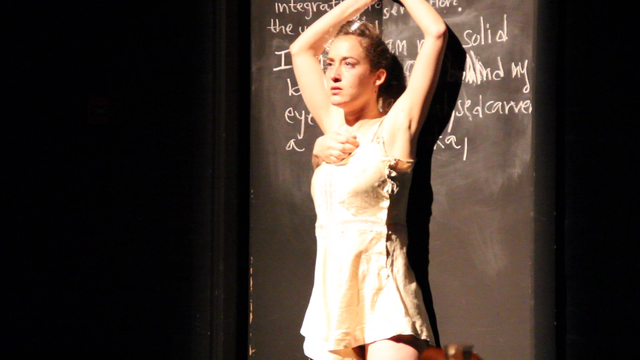
The third part of the intermedial encounter is my body. I used my body in different ways, mainly by improvisation of movement and actions related to the subject matter, objects and images.
In the process of creating the practice, I usually worked alone in the studio; but in the performance itself, I decided to add another body – a hand of a male actor, which appeared beyond the door and operated my own hand. I decided to add another body in order to enlarge the encounter and to add another tension of ‘in-between’ body to body.
During the performance my body shifted its status according to the specific encounter with the objects, images and the other body. Sometimes it was the body that acted upon object or image, operated and generated the encounter and sometimes it was the object or the image that acted upon the body. Each element of the three forms has equal significance in the process of generating a change.
Thesis
On September 2013 I submitted my thesis about “The Modified Encounter – on the relationship between intermediality and memory in performance”.
This exploration is based on the definition of intermediality as a ‘space in between the different realities that the performance creates’ (Chapple & Kattenbelt 2006:12) and on Henri Bergson’s concept of memory as ‘independent recollection’ (Bergson 2011:40) where the virtual past co-exists with the actual present. The purpose of this research is to explore the correspondences between the co-existing realities within intermediality and those that co-exist in memory and the implications these correspondences have on live performance. I apply Jacques Derrida’s notion of différance (Derrida 1991:62) a ‘differentiation that produces the effect of identity and difference between those identities’ (Deutscher 2005:29) as a lens through which I read the differentiation and relations the intermedial encounter creates.
The relationship between intermediality and memory is explored through the development of the intermedial performance practice I am. I am. I am. which focuses on the intermedial encounter between body, image and object and the subject matter of memory. It was through the development and the analysis of I am. I am. I am. that substantial new insights emerged regarding the phenomenon that takes place in the intermedial encounter in relation to memory. The outcomes of this practice as research project show that the relationship between the intermedial encounter and memory is one of correspondence, intensification and modification. The practice shows that the intermedial encounter enacts memory as a creative process in the present moment rather than presenting it as content in the past. The conclusion is that the encounter between intermediality and memory activates and heightens différance and therefore modifies all the elements that participate in the encounter, including memory itself.
Read the full thesis : “The Modified Encounter – on the relationship between intermediality and memory in performance”.
Royal Central School of Speech & Drama website.
To Jo Scott’s blog – about practice & research in the field of intermediality.
Stills photographers: Ruthie Osterman, Samuel Bear Priest, Haitham Assem Tantawy.
Beyond the archiving principle
Freudian reflections on the archive
Ruthie Osterman, London , 2013.
“It is to burn with a passion.”
(Derrida, Archive Fever, 1996:91)
In this essay I would like to analyze an artefact that I created as part of my ‘Archiving Practice’ unit in the Royal Central School of Speech and Drama by using Freud’s notion of the ‘uncanny’ (1919) and the philosopher Jacques Derrida‘s understanding of the archive as it is presented in his book Archive Fever – A Freudian Impression. Through describing and analyzing the process of creating my artefact, I will present the way I see the archive as an open, inviting and even chaotic space of encounter.
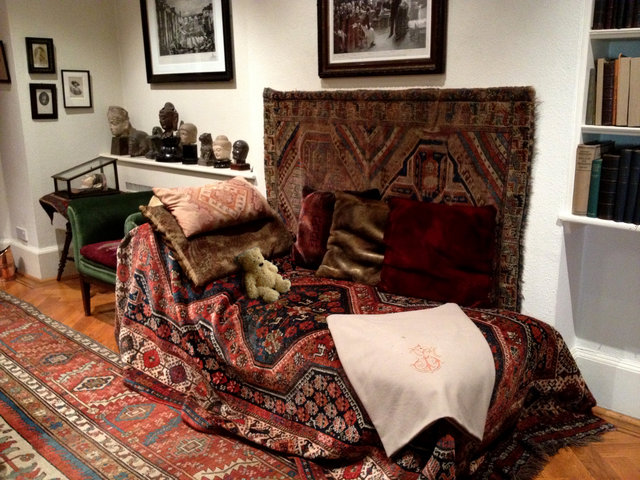
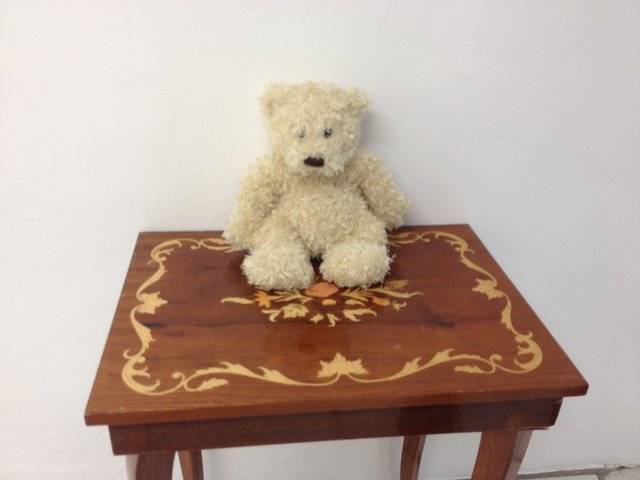
In May 2013 as part of an ‘Archiving Practice’ unit in my MA studies in London, I visited ‘Freud Museum’ for the first time. I was overwhelmed by the place and Freud’s collections, having a weird feeling that this place is familiar and unfamiliar to me at the same time. It was forbidden to photograph in the house; nevertheless, I took pictures of almost everything in the house, thinking that it is probably the best place to give freedom to my sins. (I also thought to myself that if I get caught, I will immediately lie down on the couch, ready for my psychoanalysis …) When I observed the photos I started to see and imagine things in the archive which did not really exist there. I saw my old Teddy-bear from my childhood lying-down on Freud’s couch as if it were the perfect place for it. At that moment I thought about things in the archive which do not really belong to the archive but still exist within it. They belong and don’t belong at the same time; to use Freud’s word they are ‘uncanny’ in the archive.
“At that moment I realised that there is a hierarchy within the archive and that someone should ‘take care’ and be the guard of the archive. It made me think about the inner-archive, and when I say ‘inner- archive’ I mean memory; I mean the body. Does the inner-archive have a guard too? Who controls the inner-archive and doesn’t let strange things get in? Who is the visitor of the inner-archive and what is he doing there?”
Freud, in his essay ‘The Uncanny’ (1919), explains that ‘the uncanny is that class of the terrifying which leads back to something long known to us, once very familiar.’ (Electronic version, p: 1) It is something which is unknown yet familiar at the same time. This expresses quite well the feeling that I had when I entered the Freud Museum. What caused this feeling? Freud said that ‘Something has to be added to what is novel and unfamiliar to make it uncanny’ (ibid). It is not by chance that I felt uncanny in Freud’s House. The word ‘unheimlich’ is the opposite of ‘heimlich’ which in German means ‘belonging to the home’. What kind of home/house/museum is the Freud Museum?
I decided to ‘catch that moment’ of my encounter with this archive and to ask for permission to photograph my old teddy-bear on Freud’s couch, just as I saw it in my imagination.
I will deliberate later in this essay the way I read and understand ‘archive’ as a space of encounter and performance within the archive. I wanted to create an artefact which plays with the possibilities of the archive and brings together two significant elements from two different archives: the old teddy bear from my private archive and Freud’s couch from the Freud Museum. (a public archive)
I went to the Freud Museum to introduce my idea and I was asked to contact the curator of the Museum, Miss Sophie Leighton, and the producer of the Museum, Miss Bryony Davies, through email. I did so(see appendix 1 ). I got no response. A week later, I returned to the Museum and waited in front of its main door before opening time for someone to talk to. I brought my teddy-bear with me, thinking that I might find some way to insert the teddy-bear into the house.
A man, whose position in the museum was unknown to me, was the first person to come in and I took the opportunity to ask his permission to photograph my teddy bear on Freud’s couch. He asked me a lot of questions and was very interested in my idea. After my explanation, he told me that he doesn’t think that I will be able to photograph my teddy bear on Freud’s couch but I might be able to photograph it on Anna Freud’s couch on the second floor. He explained that ‘She used to work with children and the teddy bear is from your childhood so it’s the right place’. I disagreed and told him that I was interested in putting the teddy bear only on Freud’s couch. After his failed attempts to convince me that I am actually speaking about ‘Transitional object’ or ‘forced memory’, he asked Bryony, the producer of the Museum, to come and speak with me. She explained to me the politics of the Museum, its hierarchy and why I will not be able to take this photo:
“The Couch is so precious, it is an icon and we cannot let people put things on the couch. You know, even me and Sophie (the curator), we don’t even touch the couch”
At that moment I realised that there is a hierarchy within the archive and that someone should ‘take care’ and be the guard of the archive. It made me think about the inner-archive, and when I say ‘inner- archive’ I mean memory; I mean the body. Does the inner-archive have a guard too? Who controls the inner-archive and doesn’t let strange things get in? Who is the visitor of the inner-archive and what is he doing there?
I see myself as a live archive and sometimes I can find objects, thoughts or even feelings within this archive, which do not belong to it, which do not belong to me. However, they are there. I might call them ’the uncanny in my private/inner archive’. They belong and do not belong at the same time. Yet who put them there?
I was standing in front of the producer of the Freud Museum, trying to explain to her my encounter with the archive, trying to fight for preserving the beautiful and intimate moment that I had with the archive when I saw the image of my teddy bear on the couch at the first time; but for her, the archive is closed.
I thought about Jacques Derrida coming to this house on June 4 1994, speaking about his understanding of an archive:
“As much and more than a thing of the past, before such a thing, the archive should call into question the coming of the future … it is a question of the future, the question of the future itself, the question of a response, of a promise and of a responsibility for tomorrow”
(Derrida, 1996:34-36)
Derrida, in his book Archive Fever, explains that the archive is thus not merely a question of the past. The archive is not closed, but always marked by the openness to the future. It is a question of a response. I agree with him and therefore for me the archive always holds an invitation.
I see the archive as a place for an encounter. If I had to refer to the archive as a character in a play, I would say that its main action is waiting, like a lover for his beloved. The archive is actually waiting for a partner; it’s thirsty for a relationship with the one who will come to visit it. The archive holds the past but also hold some promise for the future.
Derrida said that the archive’s biggest secret is that it’s not static. He spoke about the archive’s own performance. ‘The archive folds the past into a differed time of much future work’ (ibid) It suggests a future for the past.
I think that the archive and the act of archiving play a very interesting role in our life due to the deep connection to existential issues such as death and life. I do agree with Derrida that there is a complexity within the notion of archiving; on one hand there is a passion for the archive, as Derrida said, ‘it is to burn with a passion’ (1996:91) but on the other hand, there is some desire to destroy the archive, a ‘death drive’ within it which creates both actions:
“It is to burn with a passion. It is never to rest, interminably, for searching for the archive right where it slips away. It is to run after the archive, even if there is too much of it, right where something in it an archives itself. It is to have a compulsive, repetitive, and nostalgic desire for the archive, an irrepressible desire to return to the origin, a homesickness, a nostalgia for the return to the most archaic place of absolute commencement.”
(Derrida, Archive Fever, 1996:91)
The archive evokes longing and passion and in my case in the Freud Museum, the archive evoked also something uncanny. Derrida speaks about ‘homesickness’ and fever and therefore I think that it is not by chance that I felt the ‘uncanny’ which has something threatening within it: the desire to preserve the archive and also to destroy it at the same time. There is a tension driven by the ‘death drive’. How should I read my desire to combine these two elements, my teddy bear and the couch, as preserving or as destroying? Maybe both. Was my passion for photographing my teddy bear on the couch actually to offer chaos to the archive? Walter Benjamin in his essay Unpacking my Library says that ‘every passion borders on the chaotic, but the collector’s passion borders on the chaos of memories’ (1999:60) I think that what I saw in the Freud Museum was a chaos of memories, which invited me to add something from my own memory to that chaos.
The producer almost threw me out of the house when the man came back and started to ask more questions. He was very interested in the results of our conversation and tried to keep it up. He asked me:
“Do you have your teddy bear with you?”
At that moment I was very embarrassed, but I answered:
“Yes.”
“Can I see it?”
“Yes.”
I took out the teddy bear from my bag and showed it to the man. It was a very revealing moment. I realized what I was offering to the archive and how private and intimate was my meeting with it. I stupidly apologised:
“It’s a very simple teddy bear.”
The man took the teddy bear and said:
“I don’t think it fits the couch at all; it is much more suited to Freud’s collection”
Without thinking a lot, he took the teddy bear and went with him to the other side of the room. He started to move Freud’s small sculptures and put my teddy bear on the shelf between them. I thought to myself ‘that’s it, you are already in the archive; the performance of the archive has already started’.
“What do you think?”
I didn’t have time to answer, with the producer lowering the teddy bear off the shelf and giving it to me. She said:
“As I told you, I need to speak with Sophie, the curator, and we will send you an answer through email. Please don’t just turn up here as you did today. We will send you an answer. “
Did she realize that she was actually offering me another form of archiving? That the email itself has so much to do with archiving, as Derrida suggested nine years ago in the same lecturer? Probably not. She wanted to see me, my teddy-bear and maybe also her colleague out of the Museum. We had interrupted the silence of the archive enough for today.
On my way out the man told me:
“You should use Photoshop. You are speaking about ‘forced memory’ and not about reality. What really happened is not important. You see your teddy-bear on the couch; it doesn’t have to be there.”
When I was leaving the house, I thought about the politics and power within the archive. Derrida mentioned the Greek word ‘arkhe’ (αρχε ) for an archive, which holds a double meaning of commencement and commandment (1996). There is an issue of power and order within the archive and a question of who controls the archive. Is the archive a private or a public space? Derrida spokes about the ‘institutional passage from the private to the public’ (1996:10) when Freud’s house became a museum. But I decided not to focus my work on politics and power, although they will always be there. I wanted to stay close to the intimacy and the possibilities the archive offered me.
I thought about the form of archiving. I wanted to take a photo. Why? What was there in photography as a way of archiving that interested me?
For me, a photograph is always about killing the present, transforming it into the past and giving it a future. To use Roland Barthes’s words, the photograph is “vertigo of time” (1993:97) when you observe something which was so alive, but is already dead. Barthes also expresses the intimacy and the erotic that the archive creates when you wish to be alone with it “I need to be alone with the photographs I am looking at.” (ibid). I feel the same when I enter an archive and am highly aware of the people, if there are any, who experience the archive with me.
Derrida pointed out the importance of the form of archiving and the way it influences the content of the archive itself, because archiving is not only to preserve; it’s to produce something new ’The archivization produces as much as it records the event” (1996:17).
I decided to accept the man’s suggestion and use Photoshop, to change the way of archiving and maybe offer a new life to the archive by doing that. Derrida said that ‘what is no longer archived in the same way is no longer lived in the same way’ (Derrida 1996:18).I realized that I had to go beyond the archiving principle of documenting what really happened in the past and to create my artefact which documents my unique encounter with this archive, with the Freud Museum, while part of this encounter was the limitation of not being able to take a photo of my teddy bear on the couch and the imaginary space where it happened.
I know that my teddy bear was on the couch; it is still on the couch. As I mentioned before, the performance of the archive had already started. I took another offering of Freud himself to go ‘beyond the pleasure principle’ and I went beyond the archiving one. It was a pleasure.
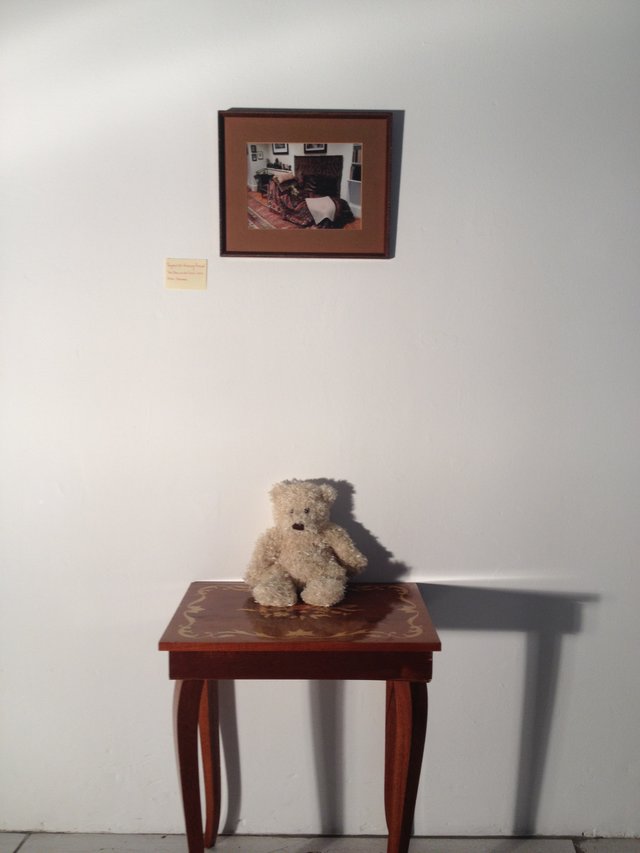 The Artefact “Beyond the archiving principle” presented at the C4CC (Centre for Creative Collaboration), London, 2013.
Bibliography
Barthes, R. (1993) Camera lucida : reflections on photography. London: Vintage.
Benjamin, W (1999) Illuminations: Unpacking my Library. London. Pimlico
Derrida, J. and Prenowitz, E. (tr.) (no date) Archive fever : a Freudian impression. Chicago: University of Chicago Press.
Freud, S. The Uncanny. An electronic version: http://web.mit.edu/allanmc/www/freud1.pdf
Freud, S. and Phillips, A. (ed.) (2006) The Penguin Freud reader. London: Penguin. (Penguin classics).
Links:
Derrida, J. Archive fever : a Freudian impression
Benjamin, W. Unpacking my Library
The princess doesn’t eat cheeseburgers
The International Fringe Theatre Festival – Acco, Israel, 2015
Suzanne Dellal Center for Dance and Theatre, Tel-Aviv, Israel, 2015
Written & Directed by Ruthie Osterman
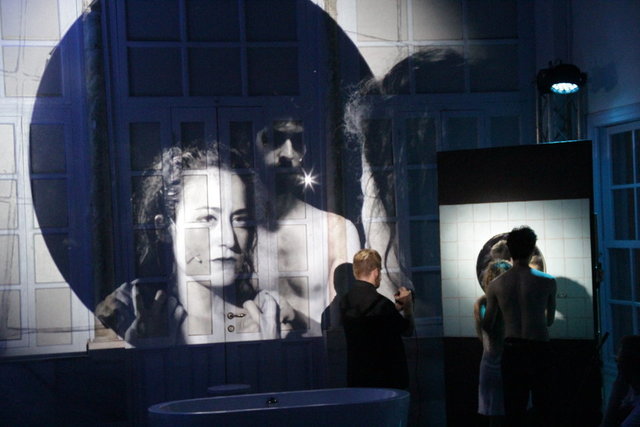 Photo: Uri Druckman
“Elaborate stage event which is variations on passion, abstract and deceptive experiment or testing of the boundaries between art and reality. Everything in this performance is layered, poetic, dark, obscured, passionate and sensual – with no room for realism … for a moment, madness become easier”
(From the review, NRG- Culture)
A post-dramatic correspondence with “The Tale of the King’s Lost Daughter” by Rabbi Nachman of Breslov.
The play examines the encounter between the live body and the screened image. It integrates cinematic and theatrical points of view, both occurring in real time.
The play is a realistic fantasy dealing with the issues of broken identity and the various layers of reality. The plot is based on an ancient legend by Rabbi Nachman of Breslov about a king who one day, in a moment of anger, said to his beloved daughter “The non-good will take you!” and then she suddenly disappeared. The king sent his servant to search for his daughter- the princess. Through a surreal and complex journey the servant managed to bring the princess back from “the non-good”, but we never find out how.
The play gives a new, contemporary and personal interpretation to the ancient legend and to an existence that is defined as “non-good”. The play raises philosophical questions about our existence and about the many layers of reality: conscious, unconscious, memory, dreams, imagination etc. The play presents a reality in which different places (such as London, Tel-Aviv and Warsaw), different times (past and present) and different dimensions (reality and imagination) co-exist and mingle with intensity.
For a full synopsis see: “The princess doesn’t eat cheeseburgers”
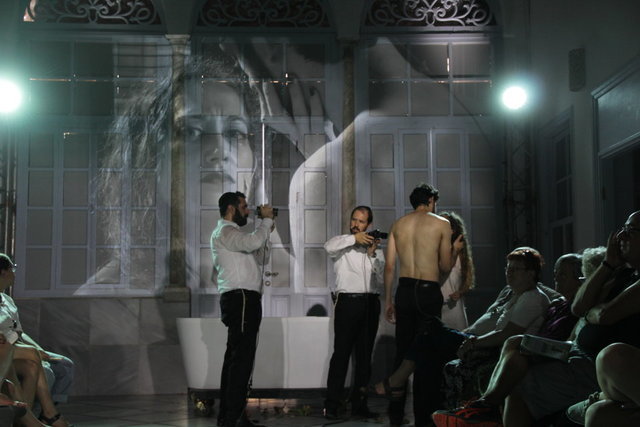 Photo: Uri Druckman
Playwright & Director
Ruthie Osterman
Asst. Director & Movement design
Nuphar Blechner
Video art:
Uri Druckman
Set & costume design:
Shani Tur
Assistant designer:
Zohar Elmaliach
Music:
Nadav Rubinstien
Lighting design:
Shachar Werechson
Production manager:
Dahna Katz
Actors:
Mutzi Aviv | Roy Calderon | Michael Charny | Dalia Friedland | Itzik Golan | Ruthie Osterman | João Telmo
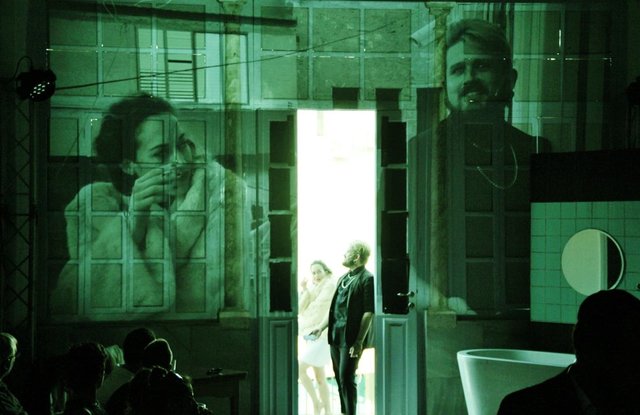 Photo: Uri Druckman
About the performance:
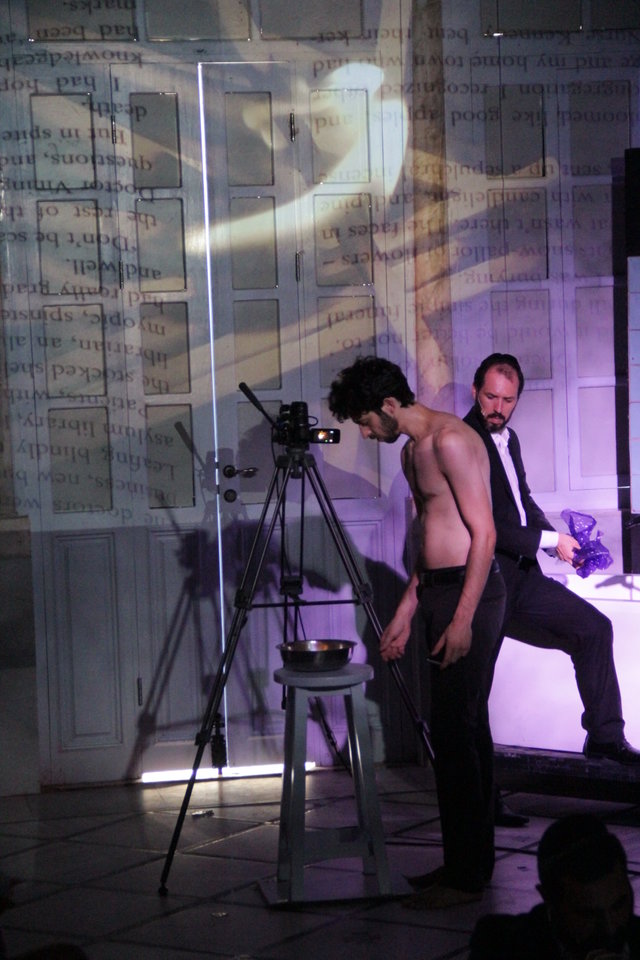
The play was first performed at The International Fringe Theatre Festival in Acre- Israel 2015. The performance took place in a unique site- an historical Arabic house where the audience was sitting in the main living room and was surrounded by the show that took place in the rooms and the main space.
The unique site allowed the audience to be part of the show and challenged their perception and senses while they could only hear or see through a screen some of the scenes that took place in the rooms, or could see a scene from different points of view: life on stage and projected on the screen at the same time.
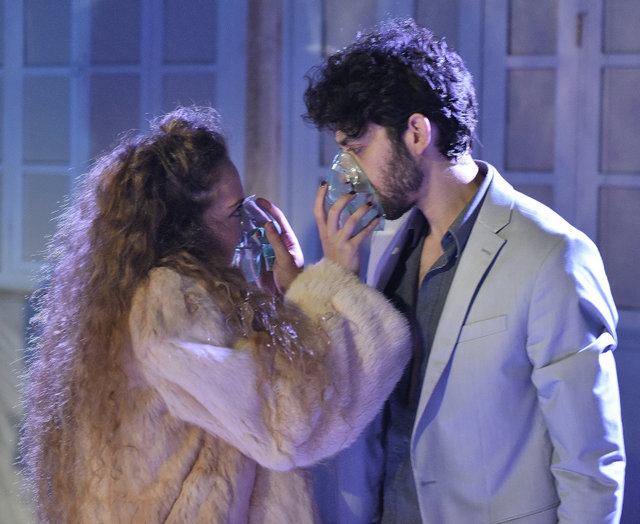 Photo: Asher Shmulevich
The Princess Doesn’t Eat Cheeseburgers – Part 1
Film photographer & editor: Tamir Platzmann
The Princess Doesn’t Eat Cheeseburgers – Part 2
Film photographer & editor: Tamir Platzmann
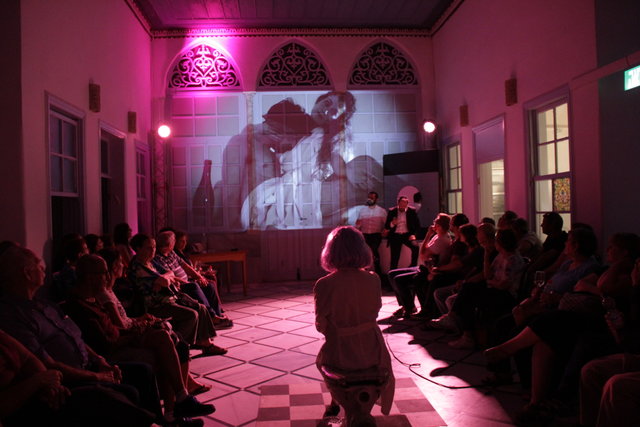
In this performance we explored the encounter between the live body and the screened image and the artistic possibilities which exist in the combination between theatre and cinema.
The show consists of seven actors and three live cameras that were operated by the actors. During the show, the actors shot the scenes and created images that were edited live by a video operator. The audience could watch the show either on the main screen or live on stage.
In each and every scene we explored the theatrical and cinematic languages and tried to create layers of meaning by the combination of them.
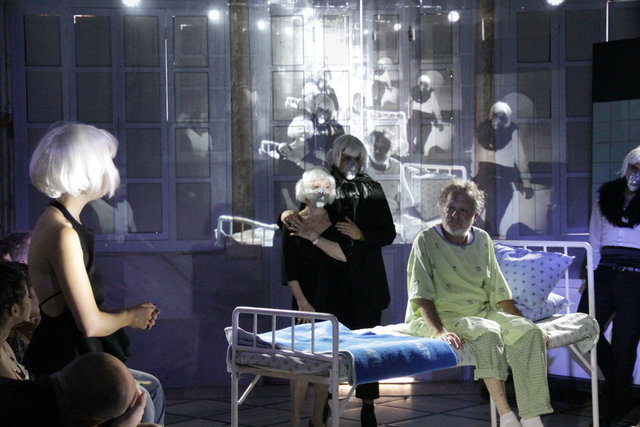
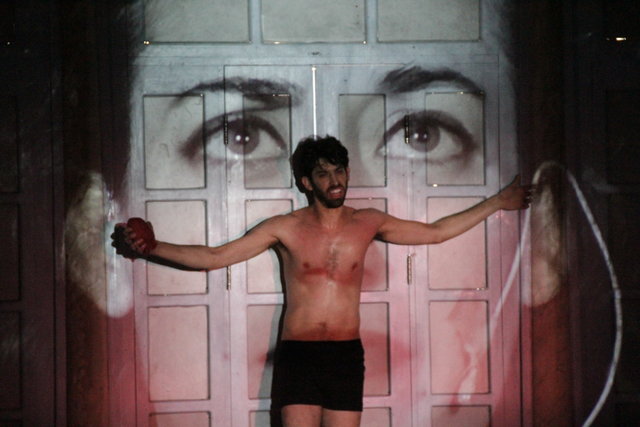 Photo : Uri Druckman
About the creative process:
The rehearsals on this play took place between July-September 2015 in Tel Aviv and later on in Acre. We worked every day for three months in the studio, improvising and exploring the unique theatrical language of the show and the combination between the media. We analyzed the ancient legend by Rabbi Nachman of Breslov and were looking for its contemporary relevance. We dealt with philosophical and existential issues that the play raises such as multiple identities, the role of a God/father and the question “what is not- good?”
During the last month before the show, the complete cast lived together in the artist-village “Ein Hod” near Acre, in order to rehears in the specific site (The Arabic house in Acre). We worked in the space, adapting the show to the house, feeling and living it from inside.
Our international cast consists of old and famous actors such as Dalia Friendland and Mutzi Aviv alongside young and promising actors such as Itzik Golan, Roy Calderon and Michael Charny, and a Portuguese actor- Joao Telmo.
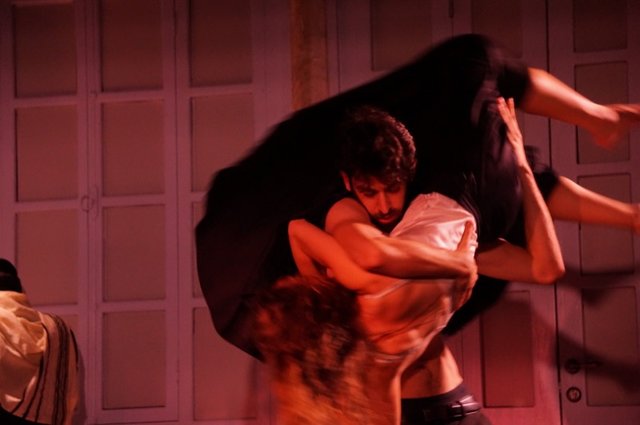 Photo:Lilach Peled-Charny
Media & Reviews
Review at the NRG – Culture / By Ofir Halel
“The Princess Doesn’r Eat Cheeseburges” at the Acco Festival
“The Princess Doesn’r Eat Cheeseburges” at The Suzanne Dellal Centre for Dance and Theatre
The show was supported by:
Mifal Hapais – the council for culture & Art
Acco Festival
Jaffa Theatre – a stage for Arab-Hebrew Culture
Alma – Home for Hebrew Culture
Analytica Management & Investment
P.M.I. Kids’ World
Polish Modern Art foundation – Dom Keret House.
Spacial thanks to:
Artistic management of the Acco Festival: Avi Gibson Barel, Gil Alon, Yuval Meskin, Frida Shoam.
Abraham Osterman, Amir Basan, Boaz Dekel, Konrad Wdowiak, Joanna Wesolowska, Sophy Turkea Yurman, Ilan Nov, Nechama Levendel , Lilach Peled-Charny, Asher Zano, Meir Blechner, Ken Mizutani and Roberto Puzone (Media department at the Royal Central School of Speech & Drama).
Thanks to God, for the good and the non-good.







Babylon Beyond Borders – R&D workshop
November 2018, Bush Theatre, London
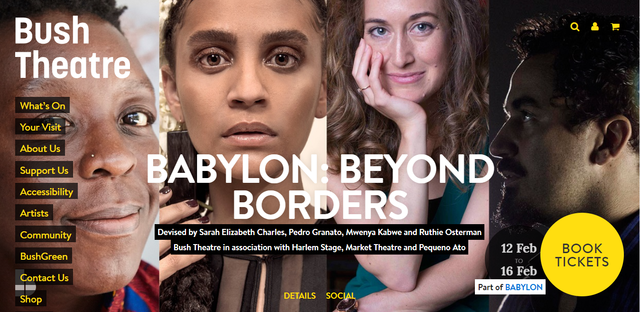
Babylon Beyond Borders is an international collaboration between the Market Theatre Lab in Johannesburg, Harlem Stage in the New York, Pequeno Ato in São Paulo and the Bush Theatre in London.
Four extraordinary theatres, each deeply rooted in its own community, collaborate and explore their relationship to Babylon and it’s meanings, from home and exile to migration and language. The outcome is performance that takes place simultaneously and projected via live stream
To read more about the project: Babylon Beyond Borders, Bush Theatre
In this project we explore the possibility of sharing one space by creating a performance that will happen in four locations simultaneously using live stream. We hope to offer our audiences the possibility a meaningful encounter with audiences and artists in around the world. This simultaneous event will celebrate cross-border solidarity and creativity.
Each theatre appointed lead artist to devise the work. Beside myself, the other lead artists are:
Pedro Granato, Artistic Director of the theatre Pequeno Ato in São Paulo, Brazil.
Mwenya Kabwe , Theatre maker from the Market Theatre Lab in Johannesburg, SA.
Sarah Elizabeth Charles, Composer and musician from Harlem Stage in New York City, US.
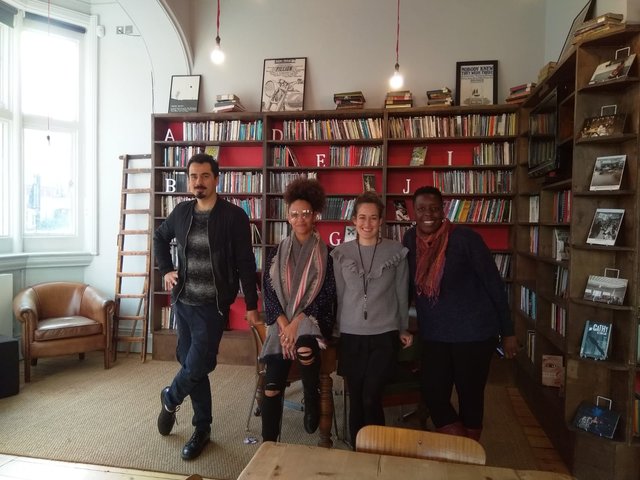 Pedro, Sarah, Ruthie and Mwenya at the Bush Theatre, London.
Workshop in London
A crucial and exciting moment in our creative process was the only moment when all four international artists met for an intensive R&D workshop at the Bush Theatre in London. Till that moment and after that moment our meetings will take place only online, but for one week, we used the old and beloved fashioned way of sitting together in the same room.
First day
Visa Application
Pedro & Mwenya arrived in London. Having Mwenya here on time was kind of a miracle. She had to go through a torturing visa application process and we were not sure if she will get it on time. A day before her flight, she’s got a phone call saying “please come to collect your passport”. To start with a miracle is always a good sign. And also, as we will see later, the visa application became a vital part of the performance. Like they say “When life gives you lemons, make lemonade…” new-agee as it might sound, it did worked like that. The visa application and the experience of the UK border control are going to play a great role in our work.
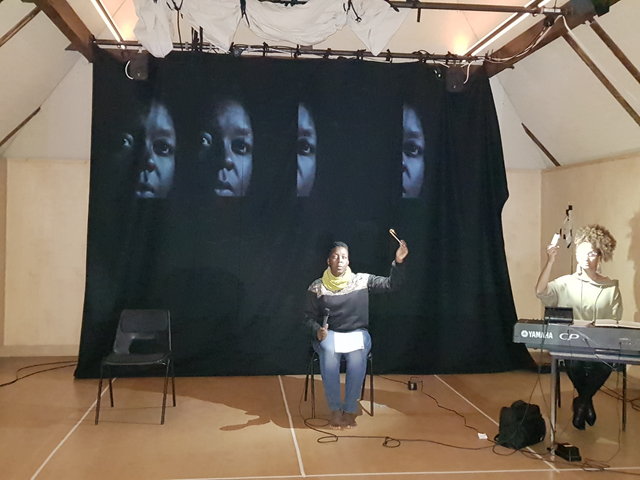 Mwenya and Sarah exploring light.
What they would like to know? Mwenya reading to us the questions from her visa application.
Encounter
First discussion was about goals. We were talking about concept and goals; why we are here? what we would like to achieve? The banal yet important questions… I was talking about the Arab Springs. I know this ended up very bad, but again, this image of squares burnt simultaneously in various places around the world, made me think a lot. Can we create an artistic action that will happen simultaneously around the world? Can it have a powerful impact?
Perhaps I should start from the very beginning – from me doubting my profession, questioning the meaning of theatre.
People ask me why I am so obsessed with international collaborations? Why I must be in one place and speak to another? Is it my Jewishness and my diasporic roots? Is it luck of satisfaction from wherever I am? Is it a childish wish to travel abroad? I think the real answer is that I believe it makes me a better person. I remember very well my first international collaboration with Polish artists. Me, who grew up with Holocaust’s survivors, who were educated to hate Polish people, to never forget and never forgive. I collaborated with the Polish people, performed on Polish soil, and yes – it was transformative and made me a better person.
I believe in the power of the encounter.
Books
Brazil is burning. Far-right candidate Jair Bolsonaro wins presidential election in Brazil . Pedro is worrying. He is going to be a father soon, and he is worrying about the future of his daughter, and about the future of his country. He sent us a link to their protest “We will fight guns with books”. Books. First association that came to mind is Heinrich Heine’s quote “Where books are burned, in the end, people will also be burned”. Well, history. An idea comes to mind, we should work with this image. I see a stage full of performers dancing with books. Perhaps an artistic action with books? Audience engagement?
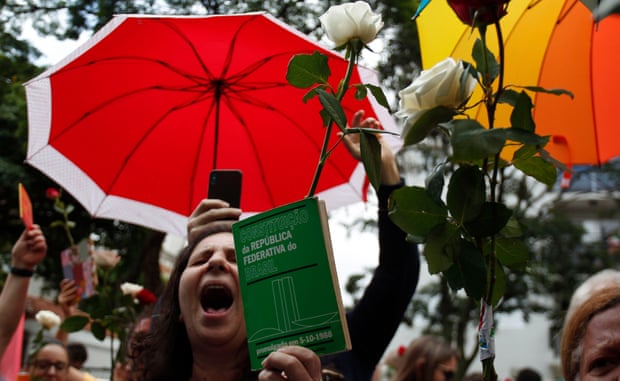 Books on the front line … a Workers Party supporter holds a Brazilian constitution during the second round of the presidential election on 28 October. Photograph: Miguel Schincariol/AFP/Getty Images
To read about Brazil’s cultural-political resistance
Possibilities
The first day of the workshop ended up with possibility. We all agreed that we would like to end the performance with a sense of possibility.
I imagine a very fragmented work, a collage. I’m not afraid of not having a linear narrative. Life is not linear. Life for me is more fragmented, broken. Identity is fragmented, broken, eclectic. So why a narrative should be linear?
We are finishing the first day with a list of inspirations, from Mujica – the mythological president of Uruguay, through Afrotopia and the Zambian “Afronaut”- who wanted to join the space race, till Charly Chaplin.
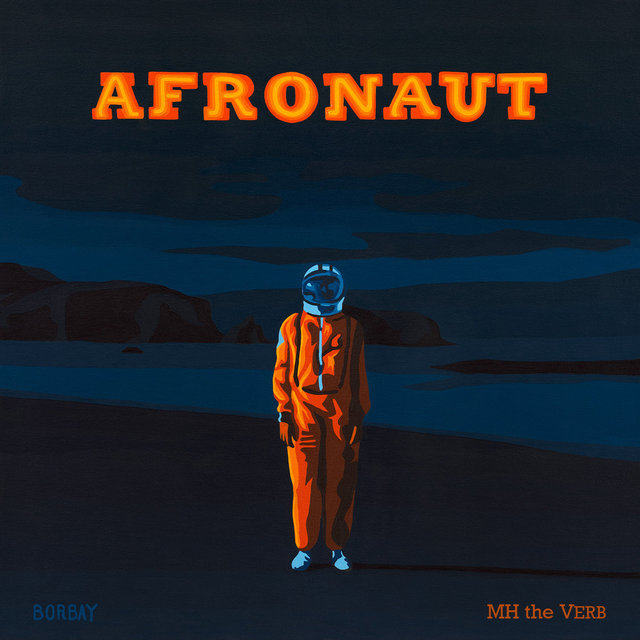 [/still-images] Conversation about Afrotopia. The Zambian “Afronaut” Who Wanted to Join the Space Race
Mujica – an inspiration
Chaplin – a possibility
Second day
We have started the day with “meet and greet” with the Bush Theatre’s staff. This is a beautiful tradition when all staff members are coming to welcome new artists/company who are coming to work in the building. Really beautiful and inspiring. We will meet the staff again for a sharing at the end of the workshop. Many people have helped me to make this workshop happen and to realize my vision for this international collaboration, many people also thought that it’s too ambitious, too conceptual, and mainly depend on budget. If there is something that I have learnt from doing international collaborations is that I must imagine that it’s already happened. There is no question about it, it’s already happen.
Then each one of us shared his/her vision, gave some background and political and social context to his/her location. What is the Market Theatre? Harlem Stage? What does it mean to work in the heart of São Paulo? And in the middle of London – the modern Babylon? From post Apartheid to Brexit to Brazil’s elections and to gun in school in Harlem. Is there a link?
We had prepared a list of questions for people from our communities. We answered those questions ourselves, Sarah was thinking of writing a song out of it. Questions. Mwenya was sharing with as a Ted lecture by Taiya Selasi, who suggested to ask alternative questions. Don’t ask where I’m from, ask where I’m a local.
Don’t ask where I’m from, ask where I’m a local | Taiye Selasi
Afternoon we invited Julian Mayard Smith, the Artistic Director of Station House Opera to speak with us about his telematic performances. Their interesting works Dissolved and Home in London & Gaza are very inspiring. Julian explored how to do something using technology that you cannot do on stage? How to occupy another space? Using live stream, you can allow one performer in London to walk in another space in Gaza, as if you are a ghost.
Card & Rules
We put all the “cards” we had on the table. Actually, I should say on the wall. By cards I mean scenes, ideas, fragments. And we were starting to discuss them, refined them, and choose the best. We also agreed on our “Dogma rules”.
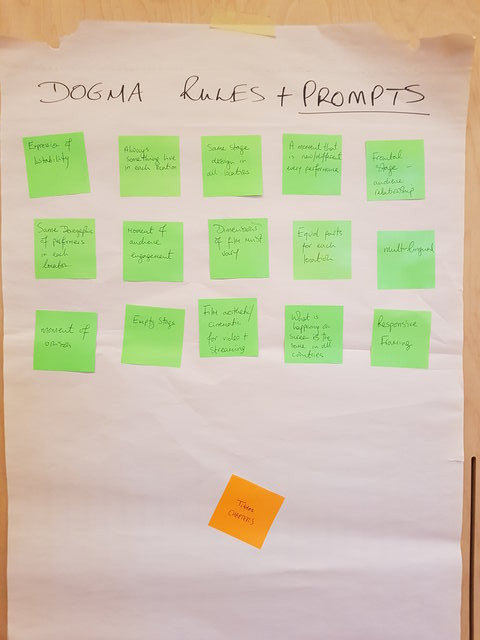 Our Dogma Rules version 1
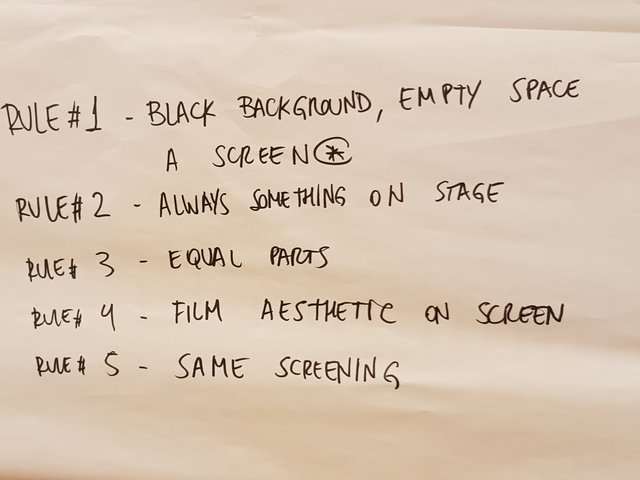 Our Dogma Rules version 2
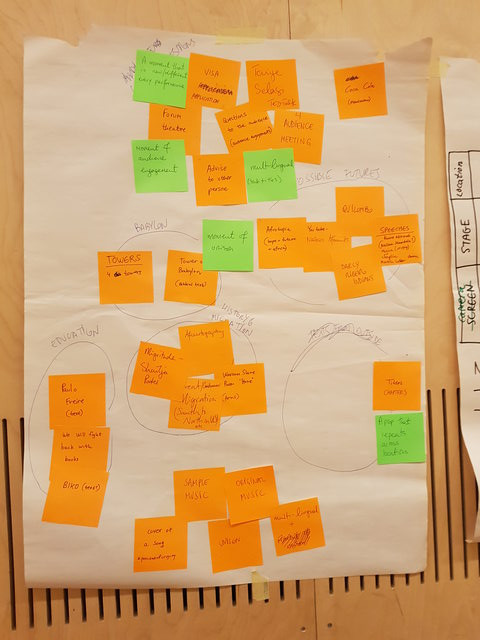 Cards
Cards
Towers of Babylon
We suddenly realized that we all have Towers connected to a traumatic event. Towers that evoke stories that tell something meaningful about our communities. Towers that evoke critical social and political topics. We shared the stories of our towers. Johannesburg has Ponte, São Paulo has the antique building of the federal police, New York City has the Twins Tower, and here in London, we have Grenfell Tower.
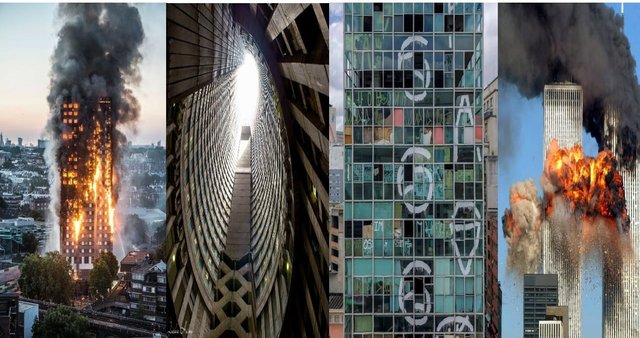
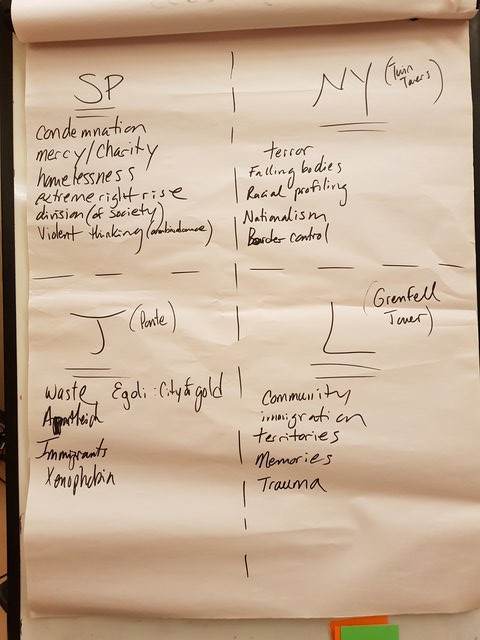 What our towers tell us? topics around our towers
Third day
Live stream. Heather, our live stream producer, explained us how it is going to work. We are going to perform live in four countries in front of live audiences, to capture what is happening on stage and live-stream it simultaneously to other three locations.
Beside it, we will live stream the all event on social media.
What is important for me is not the live stream itself, but rather the artistic and political possibilities that it allows us. So, we played with form, played with layered images from different locations, and with the relationship between the projected image and the live body etc. Live stream is a virtual journey of image and sound.
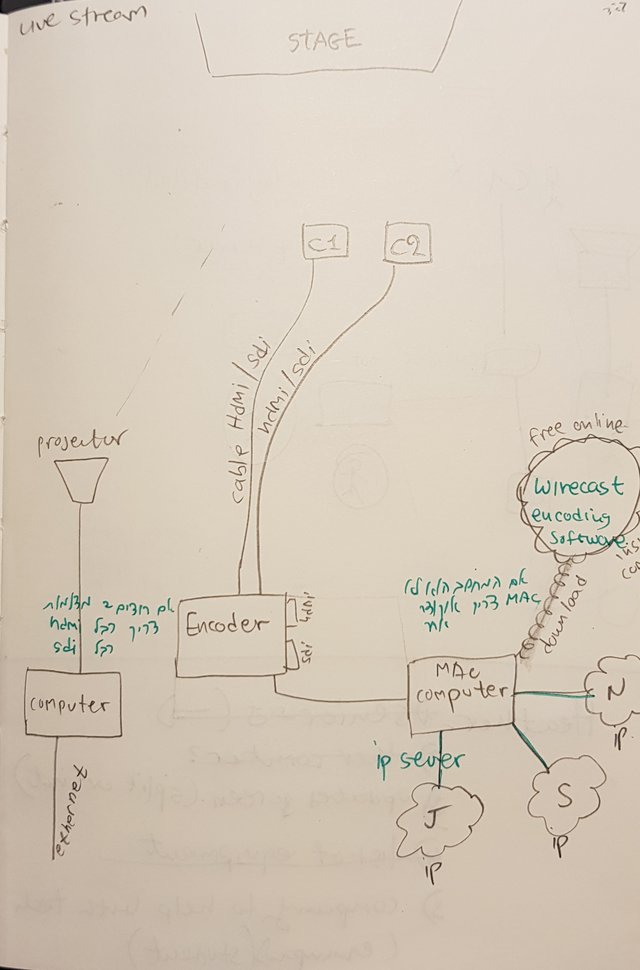 Live stream is a virtual journey of image and sound.
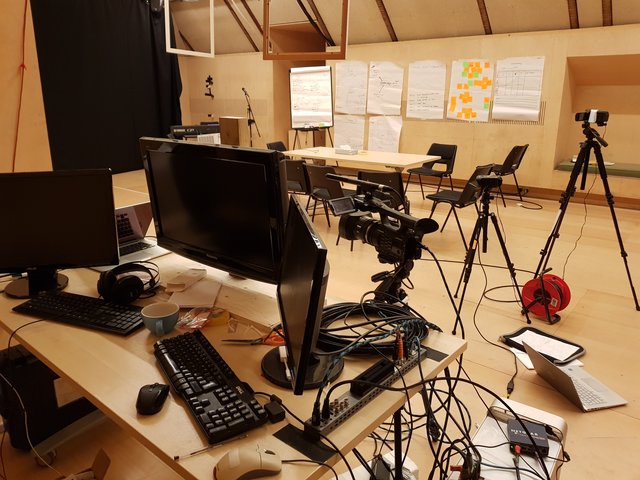
Heater shared with us a hilarious video of the talkback of the Eurovision in 1977. How to not do it…
Home
During the process we came across the amazing poet Warsan Shire. In her book “Teaching my mother how to give birth” , she has a wonderful poem “conversations about home”. We read the poem and worked with it. Sarah loved the poem and composed it.
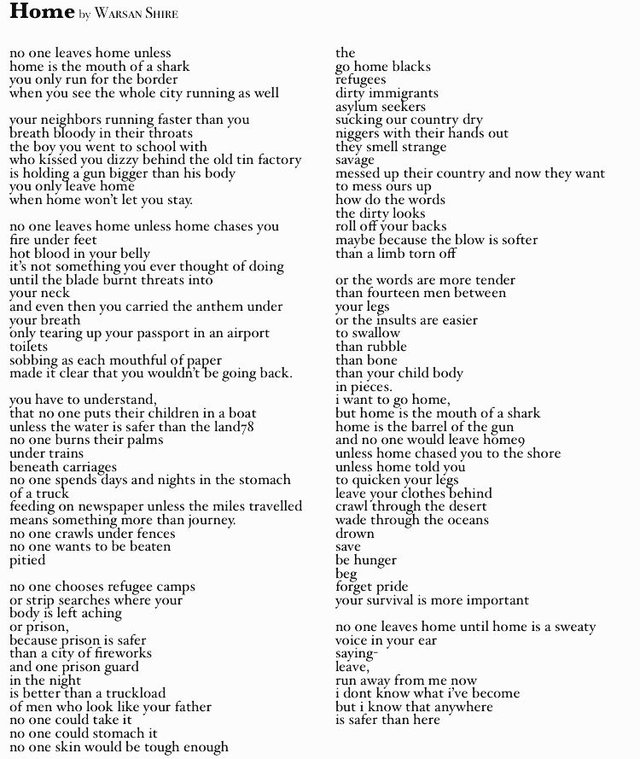
We were trying to understand what the performance is all about. To tight the concept. Perdo said it is not about towers, it is about home.
We were sitting around round table in a wine bar next to the Theatre. We were thinking about home, asking questions about home, understanding the differences between our homes, sharing our issues with our home. We were playing with words. We were looking for words with ‘home’ inside them:
Homeland, Homesick, Homeless, Homemade, Homage, Homeward, Homecoming, Hometown, Homebound, Homerun.
Sharing
On Friday morning we had a sharing with the Bush Theatre’s staff . We sent over a link, so that people could watch it online. Testing the live stream… We were facing one camera towards half of the audience, and a second one toward the other half, as if they were in two different countries. We performed two scenes and shared the concept with the team. We got warm and interesting feedback. Obviously, the fear growth as it became more and more real. We were planning ahead, wrote a work plan, scheduled our next online meetings and rehearsals . We put together all the materials we had and said goodbye. We won’t see each other anymore, at least before the performances. It is strange but also beautiful. This is what we explore – how can you create a meaningful encounter without being present in the room, how to connect to a person who is far away, how to care about another country, how to feel for other communities?
Now each of us goes away to work on its own and we will meet each other online on a weekly basis. The workshop was very good. It was very intensive, but also fun and meaningful. I’m so glad it happened. I am so looking forward to seeing what will come next. To end with possibility.
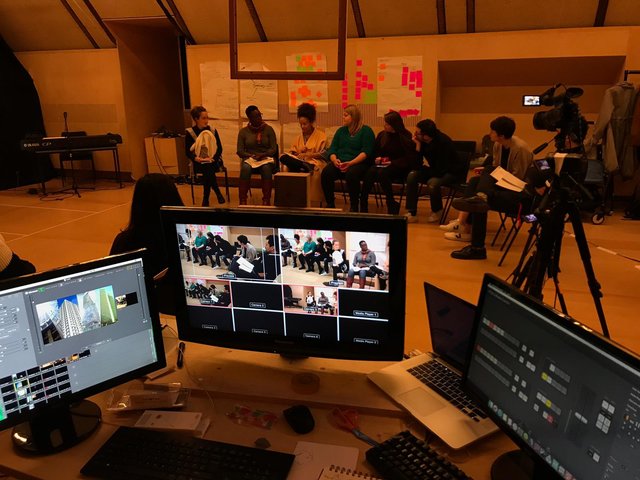 Sharing with the Bush Theatre’s staff
Sarah’s voice, R&D workshop in London, November 2018
